

Bug card No. 1402 of 1,500
Venezuelan suntiger tarantula
Psalmopoeus irminia
Name means: “irminia honours Irmi Oberhuber, the partner of the scientist who named it”
Eats: Other bugs and small animalsSpidersRainforests and jungles8 legsNot an insect, but a bug cousin
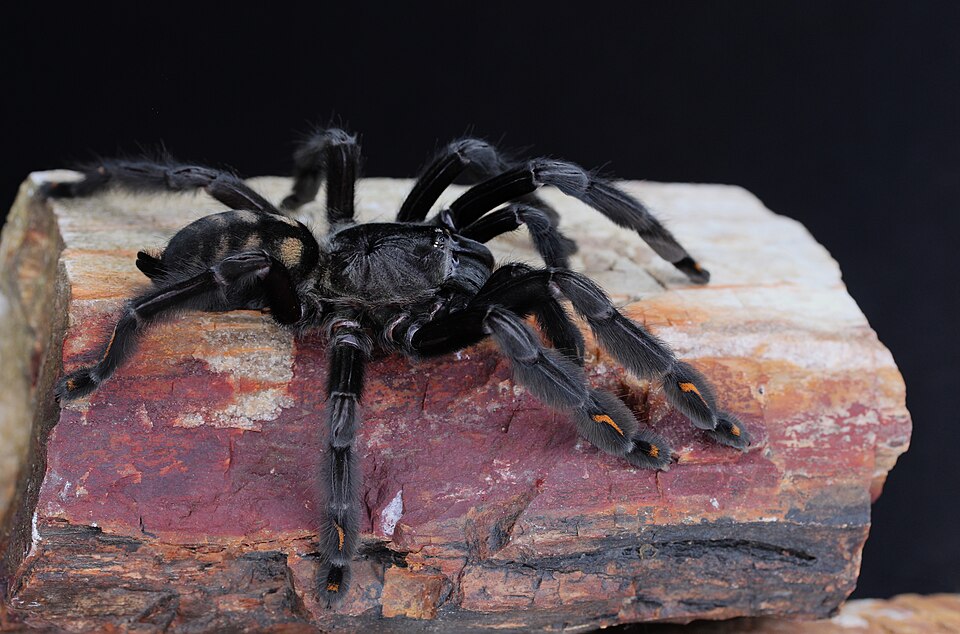
The Venezuelan suntiger tarantula is a black hairy spider with bright orange flame stripes on its legs and back. It lives up in the trees in South America. It builds a silky tube in a hole or crack to hide in.
Fun fact: spiders are not insects. Insects have six legs, spiders have eight. Everyone calls them bugs anyway!
Lives in
Venezuela, Guyana and Brazil, in trees
What does it eat?
It mostly eats insects and other small creepy-crawlies.
How fast is it?
A tortoise about 0.3 km/h (0.19 mph)
Venezuelan suntiger tarantula about 1.5 km/h (0.93 mph)
A person walking about 5 km/h (3.1 mph)
A kid running fast about 13 km/h (8.1 mph)
cool stuff
Fun facts
1
Baby suntigers have an orange-red head part and black legs, and get their flame stripes as they grow.
2
When a grown-up male gets old enough, he turns almost all grey.
3
Unlike most American tarantulas, it has no itchy hairs to flick at enemies.
4
It sometimes mixes bits of fallen leaves into the silk walls of its hideout.
you asked
Most asked questions about Venezuelan suntiger tarantula
?What does the Venezuelan suntiger tarantula eat?
Mostly insects and other small invertebrates.
?Where does the Venezuelan suntiger tarantula live?
In trees in Venezuela, Guyana and Brazil.
For bug experts
- Scientific name
- Psalmopoeus irminia
- Named by
- Saager, 1994
- Group
- Spiders
- Family
- Theraphosidae
- Classification
- Arachnida > Araneae > Theraphosidae
- Lives on
- South America
- Also known as
- Venezuelan suntiger
Where the facts come from
- Psalmopoeus irminia (Wikipedia, CC BY-SA 4.0): what it looks like, where it lives, what it eats, sizes and fun facts, retold in simple words.
- Picture by Quengsalinas. CC BY-SA 4.0, Wikimedia Commons. The round sticker of this bug is cut from the same picture.
If we got something wrong, sorry, we are bug fans, not a science journal. Tell us at [email protected] and we will fix it.
 European garden spider
 Goliath birdeater
 Brown recluse
 Redback spider
 Yellow garden spider
 Bold jumping spider
 Flatid leaf bug
 Gargantuan stick insect
 Plains cupid
 Atlas moth
 Goliath beetle
 Blue morpho