

Socotra Island blue baboon tarantula
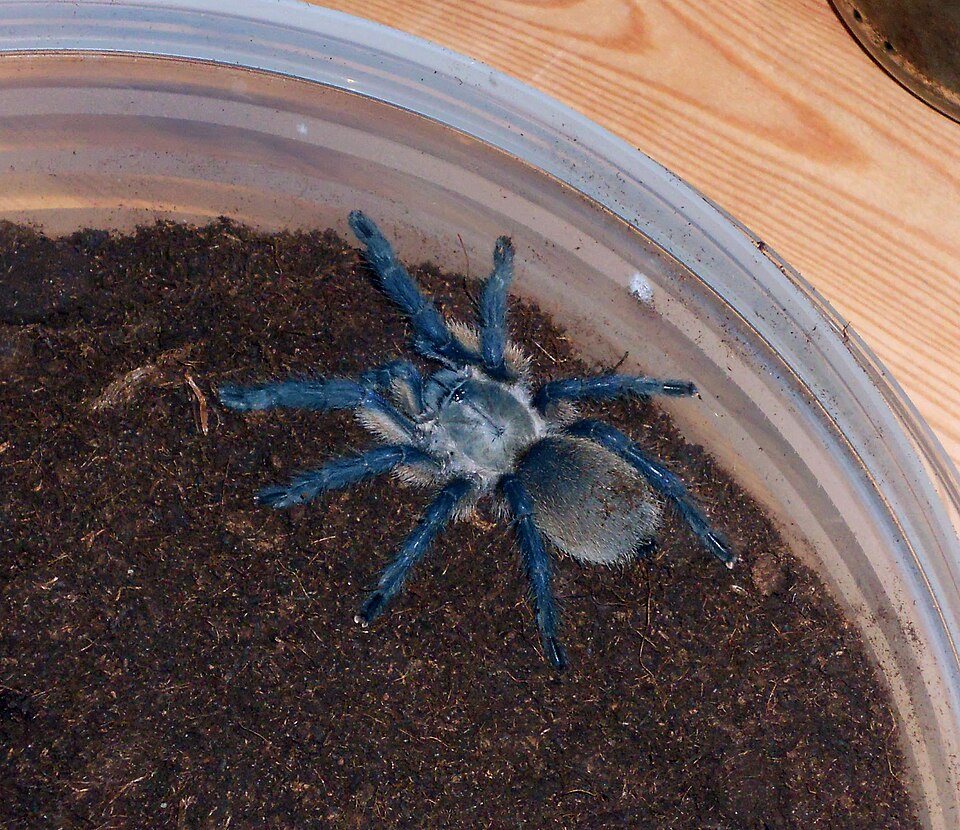
The Socotra Island blue baboon tarantula is a big, hairy spider with bright blue legs. The rest of its body is creamy grey with some blue. It comes from just one island, Socotra, far out in the sea near Yemen.
How fast is it?
Fun facts
Unlike most tarantulas, it likes company. Many of them can live close together, and mothers look after their babies.
A mother will even attack an animal that comes too close to her egg sac.
Females can live 10 to 14 years, but males only live 3 to 4 years.
Some tarantulas can flick itchy hairs at enemies, but this one cannot.
Most asked questions about Socotra Island blue baboon tarantula
?Where does the blue baboon tarantula live?
Only on Socotra, an island near Yemen that has many plants and animals found nowhere else.
?How long does a blue baboon tarantula live?
Females live about 10 to 14 years and males about 3 to 4 years.
For bug experts
- Scientific name
- Monocentropus balfouri
- Named by
- Pocock, 1897
- Group
- Spiders
- Family
- Theraphosidae
- Classification
- Arachnida > Araneae > Theraphosidae
- Lives on
- Asia
- Also known as
- Blue baboon tarantula
Where the facts come from
- Monocentropus balfouri (Wikipedia, CC BY-SA 4.0): what it looks like, where it lives, what it eats, sizes and fun facts, retold in simple words.
- Picture by Marc BRETHES. CC BY-SA 3.0, Wikimedia Commons. The round sticker of this bug is cut from the same picture.
If we got something wrong, sorry, we are bug fans, not a science journal. Tell us at [email protected] and we will fix it.
 European garden spider
 Goliath birdeater
 Brown recluse
 Redback spider
 Yellow garden spider
 Bold jumping spider
 Grayling butterfly
 Flightless dung beetle
 Blue-winged grasshopper
 Iberian camel spider
 Cochineal
 Oriental hornet