

Eastern carpenter bee
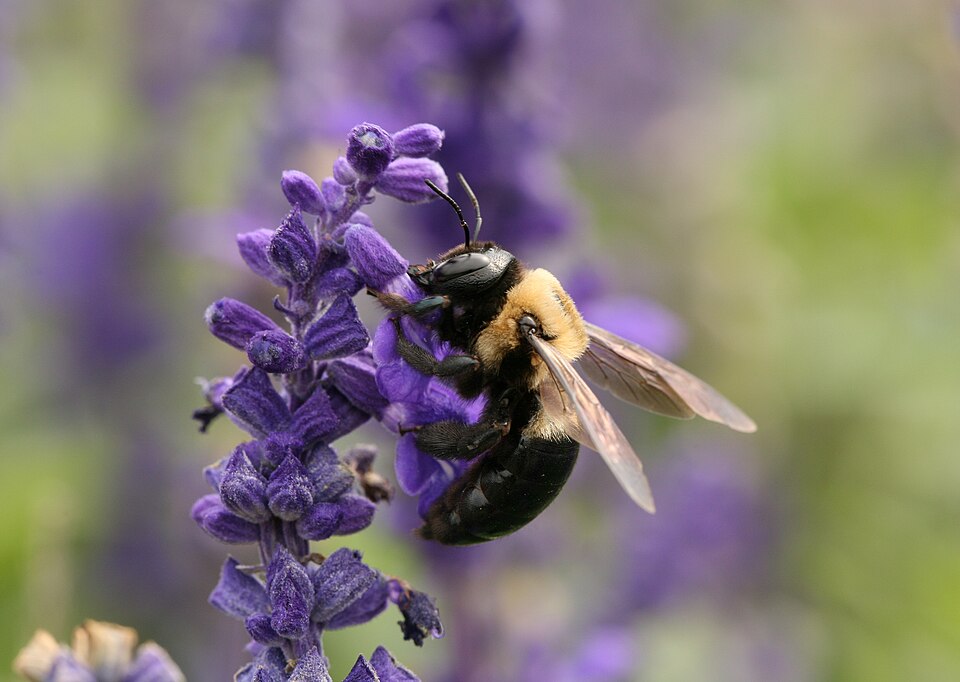
The eastern carpenter bee is as big as a bumblebee, but its body is shiny black with a faint purple gleam. It is called a carpenter because it chews tunnels into wood to make its nest. It loves wooden porches, fences and garden furniture.
How fast is it?
Fun facts
The male has a white spot on his face, so you can tell him apart from the female.
It likes pine and cedar wood best, so it often nests in houses and furniture.
It scrapes off wood shavings and uses them to build little walls between the baby rooms in its tunnel.
Several females can share one front door, but each one lays her eggs in her own tunnel.
A brand new bee has white wings. They turn brown and then bluish black.
Most asked questions about Eastern carpenter bee
?Why is it called a carpenter bee?
Because it chews tunnels into wood to build its nest, like a tiny carpenter.
?What do carpenter bees eat?
They drink nectar and collect pollen from flowers.
For bug experts
- Scientific name
- Xylocopa virginica
- Group
- Bees and bumblebees
- Family
- Apidae
- Classification
- Insecta > Hymenoptera > Apidae
- Lives on
- North America
Where the facts come from
- Eastern carpenter bee (Wikipedia, CC BY-SA 4.0): what it looks like, where it lives, what it eats, sizes and fun facts, retold in simple words.
- Picture by Daniel Schwen. CC BY-SA 4.0, Wikimedia Commons. The round sticker of this bug is cut from the same picture.
If we got something wrong, sorry, we are bug fans, not a science journal. Tell us at [email protected] and we will fix it.
 Western honey bee
 Buff-tailed bumblebee
 Violet carpenter bee
 Giant honey bee
 Wallace's giant bee
 Himalayan giant honey bee
 Urban bluebottle
 Citrus mealybug
 Museum beetle
 Lesser wax moth
 Face fly
 Cluster fly