

Face fly
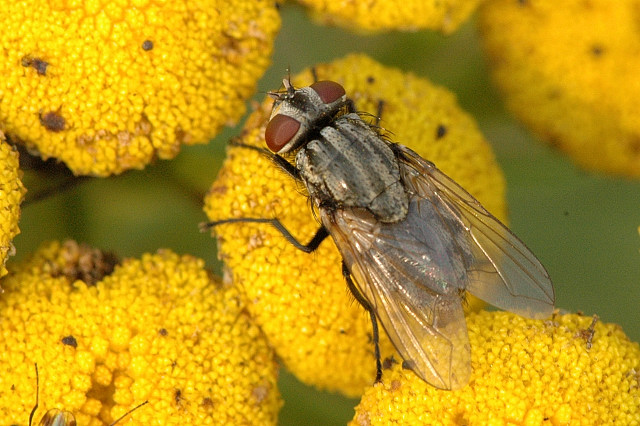
The face fly looks a lot like a house fly, just a little bigger and grey, with four dark stripes on its back. It loves cows and horses and likes to sit right on their faces. That is how it got its name.
How big is it?
How long is it?
How big is Face fly compared to YOU?
Just maths in your browser. Nothing is saved or sent anywhere.
How fast is it?
Fun facts
Mostly the females sit on animals' faces, because they need extra protein to make eggs.
Its eggs hatch just a few hours after they are laid in a fresh cow pat.
From egg to grown-up fly takes only about 10 to 20 days.
It sleeps through the winter and wakes up around March or April.
People brought it to North America by accident around the 1940s.
Most asked questions about Face fly
?Why do flies sit on cows' faces?
The face fly drinks the wet stuff around cows' eyes and noses. Females need it to make their eggs.
?Is the face fly dangerous?
It does not bite people, but it can spread eye illnesses among cows and horses.
?How big is a face fly?
About 7 to 8 millimetres long, a little bigger than a house fly.
For bug experts
- Scientific name
- Musca autumnalis
- Group
- Flies and mosquitoes
- Family
- Muscidae
- Classification
- Insecta > Diptera > Muscidae
- Lives on
- Europe, Asia, Africa, North America
- Also known as
- Autumn housefly
Where the facts come from
- Musca autumnalis (Wikipedia, CC BY-SA 4.0): what it looks like, where it lives, what it eats, sizes and fun facts, retold in simple words.
- Picture by James K. Lindsey. CC BY-SA 3.0, Wikimedia Commons. The round sticker of this bug is cut from the same picture.
If we got something wrong, sorry, we are bug fans, not a science journal. Tell us at [email protected] and we will fix it.
 Housefly
 New World screwworm fly
 Lovebug
 Tsetse fly
 Common fruit fly
 Asian tiger mosquito
 Japanese yellow hornet
 Citrus mealybug
 Meal moth
 Harlequin cockroach
 Australian house centipede
 Pig louse