

Bug card No. 1407 of 1,500
Violet carpenter bee
Xylocopa violacea
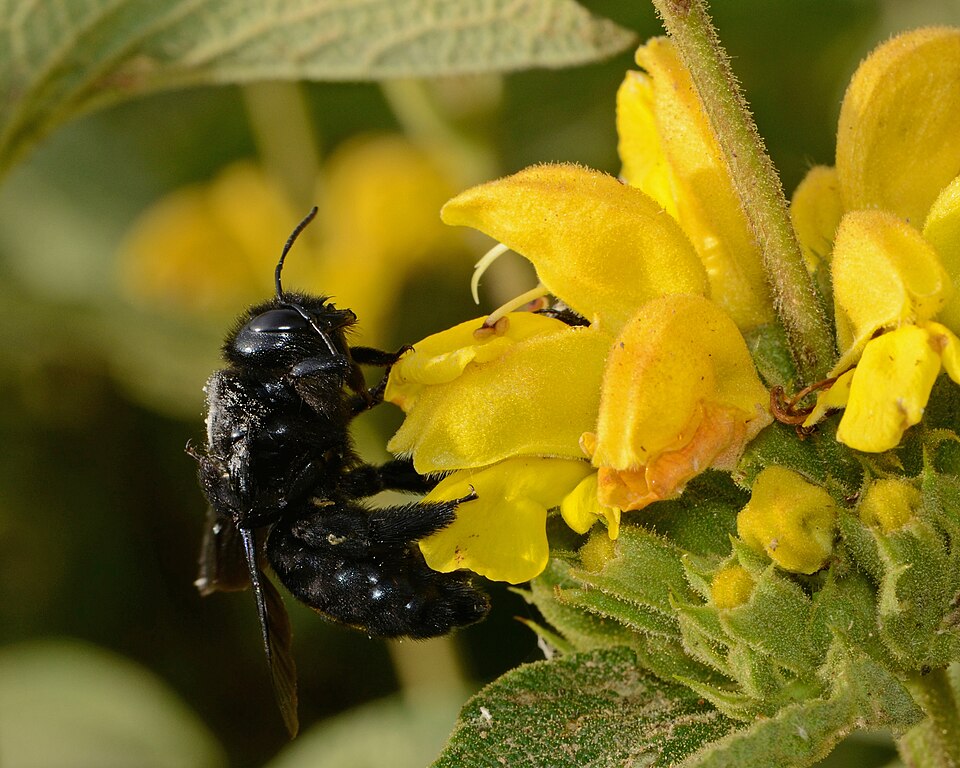
The violet carpenter bee is one of the biggest bees in Europe. It is shiny black, and its wings shimmer blue and violet in the sun. It is called a carpenter because the mother chews tunnels into dead wood to make her nest.
Lives in
Europe and Asia, as far east as China, in gardens and meadows with old wood
What does it eat?
The grown-ups visit flowers. The mother leaves a ball of pollen in each little room of her nest, so her babies have food.
How fast is it?
A kid running fast about 13 km/h (8.1 mph)
Violet carpenter bee about 22 km/h (14 mph)
A grown-up on a bike about 25 km/h (16 mph)
A car driving in town about 50 km/h (31 mph)
cool stuff
Fun facts
1
The mother builds the nest all on her own, with no helpers.
2
Inside the wooden tunnel she makes a row of little rooms, one egg in each.
3
The grown-ups sleep through the winter in old wooden tunnels and wake up in spring, around April or May.
you asked
Most asked questions about Violet carpenter bee
?Why is it called a carpenter bee?
Because the female chews tunnels into dead wood to build her nest, like a little carpenter.
?Where does the violet carpenter bee live?
In Europe and Asia, wherever there are flowers and dead wood to nest in.
For bug experts
- Scientific name
- Xylocopa violacea
- Group
- Bees and bumblebees
- Family
- Apidae
- Classification
- Insecta > Hymenoptera > Apidae
- Lives on
- Europe, Asia
Where the facts come from
- Xylocopa violacea (Wikipedia, CC BY-SA 4.0): what it looks like, where it lives, what it eats, sizes and fun facts, retold in simple words.
- Picture by Gideon Pisanty ( Gidip ) גדעון פיזנטי. CC BY 3.0, Wikimedia Commons. The round sticker of this bug is cut from the same picture.
If we got something wrong, sorry, we are bug fans, not a science journal. Tell us at [email protected] and we will fix it.
 Western honey bee
 Buff-tailed bumblebee
 Giant honey bee
 Wallace's giant bee
 Himalayan giant honey bee
 Eastern honey bee
 Sickle-bearing bush-cricket
 Green milkweed locust
 Regal fritillary
 Spine-tailed earwig
 Checkered white
 Mexican fruit fly