

Brown widow
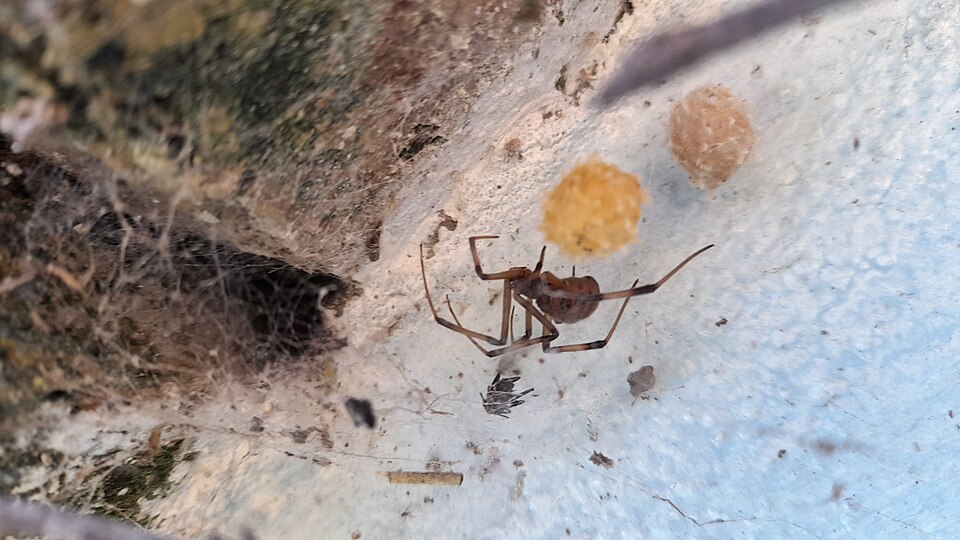
The brown widow is a cousin of the black widow. It is tan, brown or grey, with a black and white pattern on its back and an orange hourglass under its belly. It often lives in dark corners around houses.
How fast is it?
Fun facts
Its egg sacks are easy to spot: they are round and covered in little spikes, like a burr.
A mother can make 20 egg sacks in her life, with 120 to 150 eggs in each one.
Its name geometricus comes from the shape pattern on its back.
In California it seems to be pushing the black widows out of their homes.
Some wasps, like mud daubers, hunt brown widows to feed their babies.
Most asked questions about Brown widow
?How can you tell a brown widow from a black widow?
The brown widow is lighter in colour, has an orange hourglass and a black and white pattern on its back, and makes spiky egg sacks.
?Where do brown widows live?
In warm places around the world, often around houses, sheds and garden furniture.
For bug experts
- Scientific name
- Latrodectus geometricus
- Group
- Spiders
- Family
- Theridiidae
- Classification
- Arachnida > Araneae > Theridiidae
- Lives on
- Africa, North America, South America, Asia, Australia and Oceania, Europe
- Also known as
- Brown button spider, Grey widow, House button spider, Geometric button spider
Where the facts come from
- Latrodectus geometricus (Wikipedia, CC BY-SA 4.0): what it looks like, where it lives, what it eats, sizes and fun facts, retold in simple words.
- Picture by H Capovilla Pablo H Capovilla. CC BY-SA 4.0, Wikimedia Commons. The round sticker of this bug is cut from the same picture.
If we got something wrong, sorry, we are bug fans, not a science journal. Tell us at [email protected] and we will fix it.
 European garden spider
 Goliath birdeater
 Brown recluse
 Redback spider
 Yellow garden spider
 Bold jumping spider
 Hide beetle
 Red-legged ham beetle
 Horn fly
 Face fly
 Cluster fly
 Hen flea