

Widow skimmer
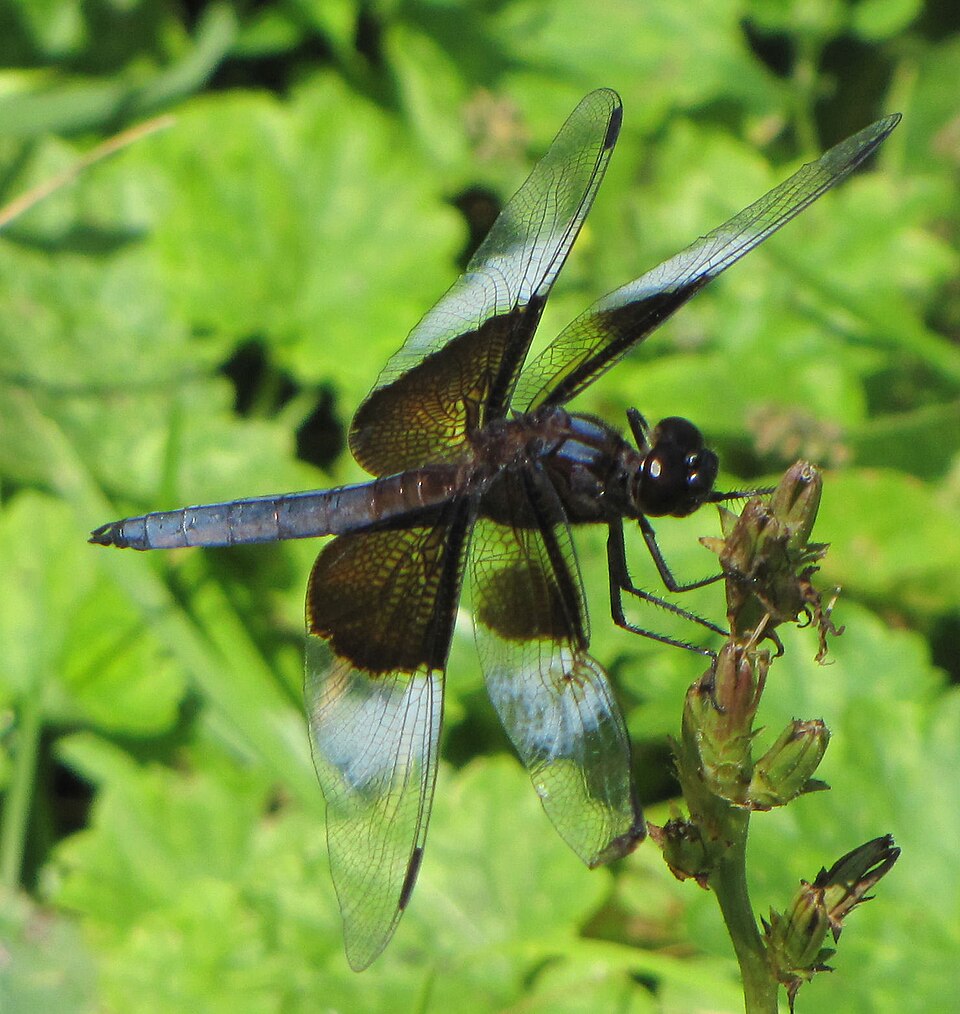
The widow skimmer is a chunky dragonfly with big dark bands at the base of its wings. The males have a steel blue body, and as they grow up they get bright white patches in the middle of their wings. The females are yellow with brown stripes.
How fast is it?
Fun facts
Its babies, called nymphs, live in the water and shed their skin many times as they grow.
When it is ready, the nymph climbs out of the water and sheds its skin one last time to show its wings.
Its huge eyes meet in the middle of its head.
When it rests, it keeps its wings spread out flat.
Its tail end alone is about 2.5 to 3 centimetres long.
Most asked questions about Widow skimmer
?Is the widow skimmer dangerous?
No. It cannot sting and is harmless to people.
?What does the widow skimmer eat?
Other insects, such as mosquitoes.
?Where does the widow skimmer live?
Near ponds, lakes and slow streams across most of the United States and southern Canada.
For bug experts
- Scientific name
- Libellula luctuosa
- Group
- Dragonflies and damselflies
- Family
- Libellulidae
- Classification
- Insecta > Odonata > Libellulidae
- Lives on
- North America
Where the facts come from
- Widow skimmer (Wikipedia, CC BY-SA 4.0): what it looks like, where it lives, what it eats, sizes and fun facts, retold in simple words.
- Picture by D. Gordon E. Robertson. CC BY-SA 3.0, Wikimedia Commons. The round sticker of this bug is cut from the same picture.
If we got something wrong, sorry, we are bug fans, not a science journal. Tell us at [email protected] and we will fix it.
 Emperor dragonfly
 Common whitetail
 Green darner
 Ebony jewelwing
 Globe skimmer
 Blue dasher
 Great silver water beetle
 Pond olive
 Seashore springtail
 Baltic isopod
 Lesser water boatman
 Palamedes swallowtail