

Baltic isopod
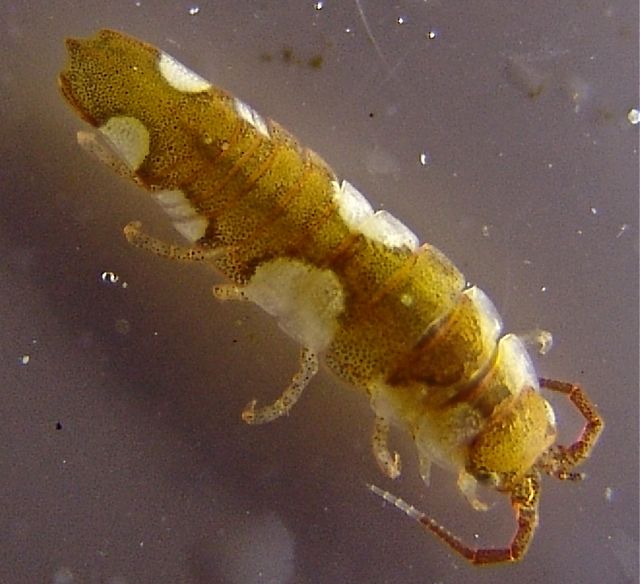
The Baltic isopod is a little sea cousin of the woodlouse. It lives on seaweed and seagrass in the sea. It can be green, brown or black with silver, and it can even change how bright its colours are, so fish and crabs have a hard time spotting it.
How big is it?
How long is it?
How big is Baltic isopod compared to YOU?
Just maths in your browser. Nothing is saved or sent anywhere.
How fast is it?
Fun facts
Males are much bigger than females. A male can reach 4 centimetres, while a female is less than 2.
In 2022 scientists found that it helps a red seaweed make babies, like a bee helps flowers. It was the first animal known to do this.
During the day it hides, and at night it moves around to find food.
Females are usually darker, and males are often light green.
It has 14 legs, just like a woodlouse.
Most asked questions about Baltic isopod
?Is the Baltic isopod a woodlouse?
It is a close cousin. Both are isopods, but this one lives in the sea.
?What does the Baltic isopod eat?
Mostly seaweed and sea plants, especially bladderwrack.
?How big is the Baltic isopod?
Males grow up to 4 centimetres, and females to about 1.8 centimetres.
For bug experts
- Scientific name
- Idotea balthica
- Named by
- Pallas, 1772
- Group
- Woodlice
- Family
- Idoteidae
- Classification
- Malacostraca > Isopoda > Idoteidae
- Lives on
- Europe, North America, Asia, Africa
- Also known as
- Smooth seaweed isopod
Where the facts come from
- Idotea balthica (Wikipedia, CC BY-SA 4.0): what it looks like, where it lives, what it eats, sizes and fun facts, retold in simple words.
- Picture by Mark Blaxter. Public domain, Wikimedia Commons. The round sticker of this bug is cut from the same picture.
If we got something wrong, sorry, we are bug fans, not a science journal. Tell us at [email protected] and we will fix it.
 Common pill bug
 Tongue-eating louse
 Giant isopod
 Sea slater
 Common rough woodlouse
 Wharf roach
 Two-tailed swallowtail
 Jumbo dragonfly
 Horse leech
 Petroleum fly
 Buzzer midge
 Scarlet dragonfly