

Tongue-eating louse
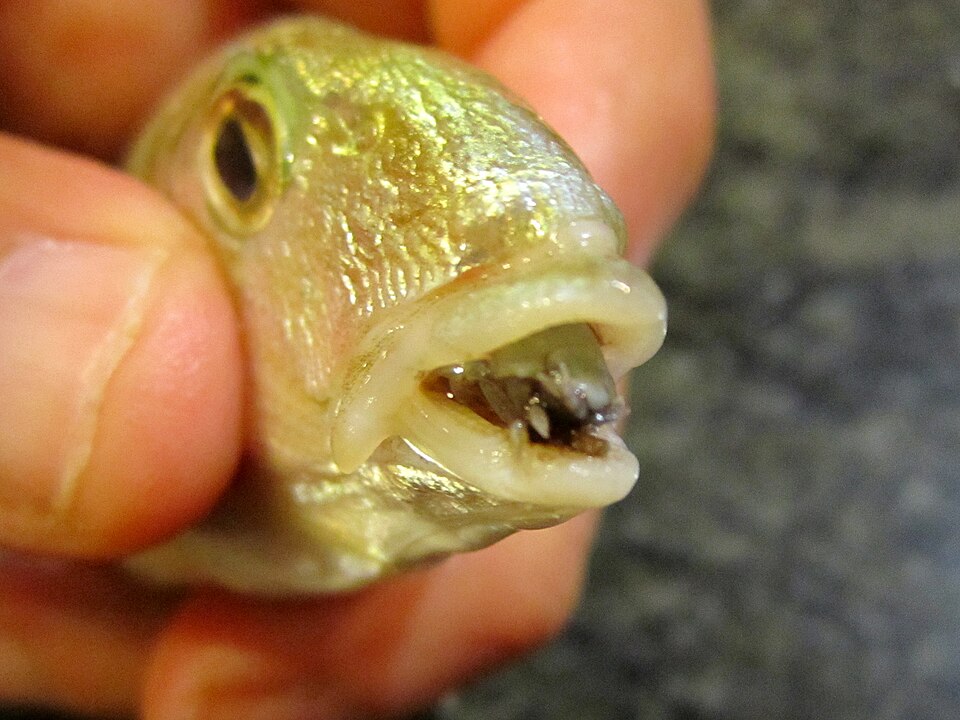
The tongue-eating louse is a sea cousin of the woodlice you find under stones. It has a flat body made of segments and 14 sharp legs. It lives inside the mouth of a fish and does a very strange job: it takes the place of the fish's tongue.
How big is it?
How long is it?
How big is Tongue-eating louse compared to YOU?
Just maths in your browser. Nothing is saved or sent anywhere.
How fast is it?
Fun facts
It is the only animal known to take the place of a body part of another animal.
The fish can still use it like a tongue to hold its food.
Every one starts life as a male, and some turn into females later.
It can live for up to three years and grows together with its fish.
A mother carries more than 400 eggs in a pouch under her body, like all woodlice do.
Most asked questions about Tongue-eating louse
?Is the tongue-eating louse dangerous to people?
No. It only lives in the mouths of fish.
?What does the tongue-eating louse do?
It gets into a fish's mouth through the gills, holds on to the tongue until the tongue is gone, and then works as the fish's new tongue.
?How big is the tongue-eating louse?
Females are 8 to 29 millimetres long, and males about 7.5 to 15 millimetres.
For bug experts
- Scientific name
- Cymothoa exigua
- Group
- Woodlice
- Family
- Cymothoidae
- Classification
- Malacostraca > Isopoda > Cymothoidae
- Lives on
- North America, South America
Where the facts come from
- Cymothoa exigua (Wikipedia, CC BY-SA 4.0): what it looks like, where it lives, what it eats, sizes and fun facts, retold in simple words.
- Picture by Marco Vinci. CC BY-SA 3.0, Wikimedia Commons. The round sticker of this bug is cut from the same picture.
If we got something wrong, sorry, we are bug fans, not a science journal. Tell us at [email protected] and we will fix it.
 Common pill bug
 Giant isopod
 Sea slater
 Common rough woodlouse
 Wharf roach
 Water louse
 North American medicinal leech
 Common whitetail
 Eastern dobsonfly
 Waterfall centipede
 Globe skimmer
 Fen raft spider