

Six-eyed sand spider
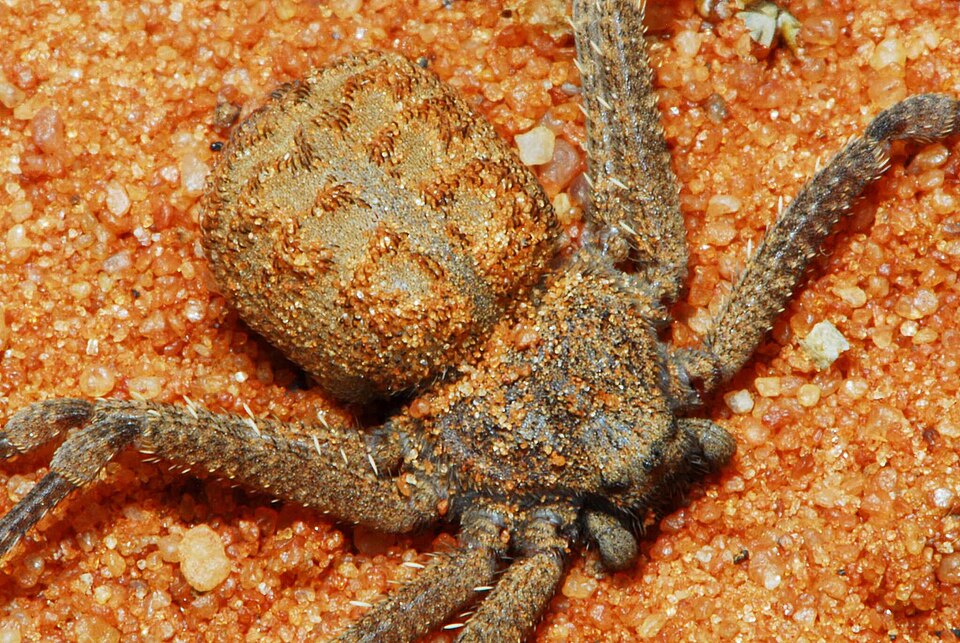
The six-eyed sand spider is a flat, crab-like spider from the sandy deserts of southern Africa. Its body is covered in short, velvety hairs that catch sand, so it almost disappears into the ground. It has six eyes instead of eight and does not build a web.
How fast is it?
Fun facts
It hides under stones, in sand at the entrances of animal burrows, and at the bottom of cliffs.
Its long, wide legs let it scurry across loose sand very fast when it is disturbed.
Its six eyes sit in three pairs, good for seeing movement close to the ground.
Most asked questions about Six-eyed sand spider
?How does the six-eyed sand spider hide?
It flattens itself on the ground and lets sand stick to its hairy body, so it looks just like the ground.
?Where does the six-eyed sand spider live?
In deserts and dry, sandy places in Namibia, Zimbabwe and South Africa.
For bug experts
- Scientific name
- Hexophthalma hahni
- Named by
- Karsch, 1878
- Group
- Spiders
- Family
- Sicariidae
- Classification
- Arachnida > Araneae > Sicariidae
- Lives on
- Africa
- Also known as
- Hahn's six-eyed sand spider, Six-eyed crab spider
Where the facts come from
- Hexophthalma hahni (Wikipedia, CC BY-SA 4.0): what it looks like, where it lives, what it eats, sizes and fun facts, retold in simple words.
- Picture by Peter Webb. CC BY 4.0, Wikimedia Commons. The round sticker of this bug is cut from the same picture.
If we got something wrong, sorry, we are bug fans, not a science journal. Tell us at [email protected] and we will fix it.
 European garden spider
 Goliath birdeater
 Brown recluse
 Redback spider
 Yellow garden spider
 Bold jumping spider
 Namib desert beetle
 Red-banded sand wasp
 Fog-basking beetle
 Witchetty grub moth
 Green tiger beetle
 Honeypot ant