

Bug card No. 1179 of 1,500
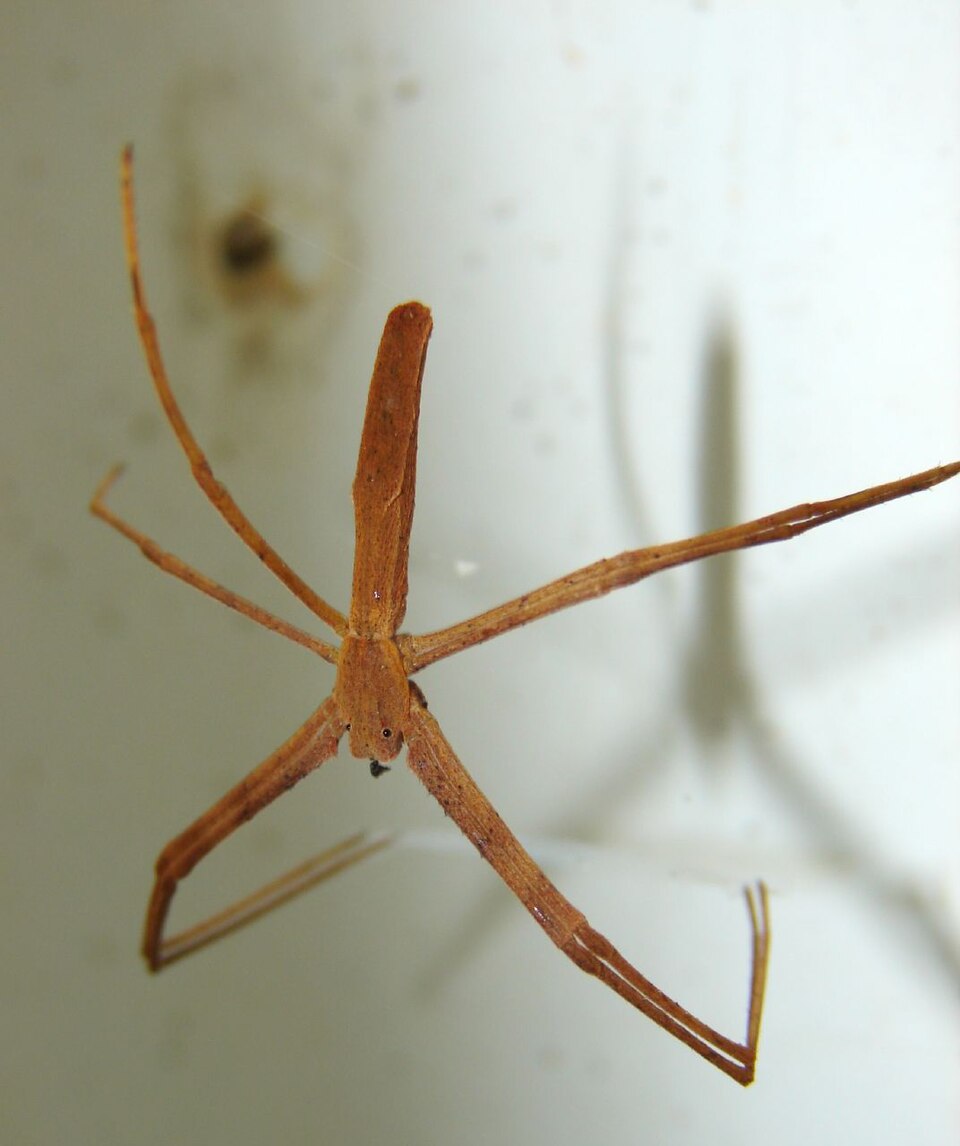
Rufous net-casting spider
Deinopis subrufa
Name means: “subrufa is Latin for reddish”
At night it holds a little stretchy silk net and throws it over insects that walk or fly past. It can be fawn, pinkish brown or chocolate brown.
Fun fact: spiders are not insects. Insects have six legs, spiders have eight. Everyone calls them bugs anyway!
Lives in
Eastern Australia and New Zealand, in forests, woodlands and heaths
Length
2.2 to 2.5 cm (0.87 to 0.98 in)
females are a little bigger than malesWhat does it eat?
It catches ants, beetles, crickets and even other spiders in its net.
How big is it?
How long is it?
🍚as long as 4 grains of rice in a row🍽️could run across a dinner table in 1.9 seconds⚡moves 21 times its own body length every second
How big is Rufous net-casting spider compared to YOU?
Just maths in your browser. Nothing is saved or sent anywhere.
How fast is it?
A tortoise about 0.3 km/h (0.19 mph)
Rufous net-casting spider about 1.9 km/h (1.2 mph)
A person walking about 5 km/h (3.1 mph)
A kid running fast about 13 km/h (8.1 mph)
cool stuff
Fun facts
1
It hunts at night and has excellent eyesight in the dark.
2
The mother makes a round egg sac about 1 centimetre wide with 100 to 200 eggs inside.
3
She hides the egg sac with a leaf, and the babies hatch after about three weeks.
4
A boy gently plucks the girl's web to tell her he is there.
5
Sometimes you can find it on the outside walls of houses.
For bug experts
- Scientific name
- Deinopis subrufa
- Named by
- Koch, 1878
- Group
- Spiders
- Family
- Deinopidae
- Classification
- Arachnida > Araneae > Deinopidae
- Lives on
- Australia and Oceania
Where the facts come from
- Asianopis subrufa (Wikipedia, CC BY-SA 4.0): what it looks like, where it lives, what it eats, sizes and fun facts, retold in simple words.
- Picture by Aussiegall. CC BY 2.0, Wikimedia Commons. The round sticker of this bug is cut from the same picture.
If we got something wrong, sorry, we are bug fans, not a science journal. Tell us at [email protected] and we will fix it.
 European garden spider
 Goliath birdeater
 Brown recluse
 Redback spider
 Yellow garden spider
 Bold jumping spider
 Spitfire sawfly
 American carrion beetle
 Pigeon tremex
 Telephone-pole beetle
 Reddish-brown stag beetle
 Banded sugar ant