

Orange-legged furrow bee
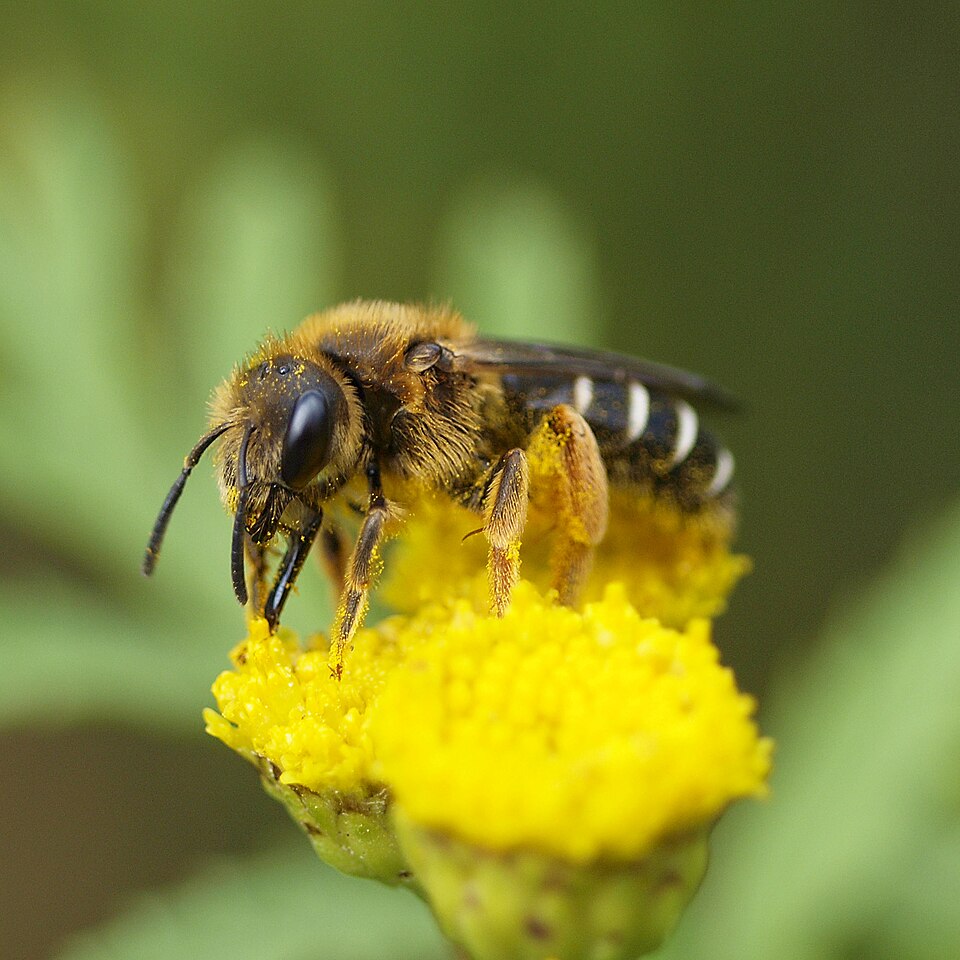
The orange-legged furrow bee is a small brown bee with thin white stripes on its body and rusty orange legs. It digs its nest in the ground, often on a sunny slope. Some of these bees live alone and some live in little families.
How big is it?
How long is it?
How big is Orange-legged furrow bee compared to YOU?
Just maths in your browser. Nothing is saved or sent anywhere.
How fast is it?
Fun facts
It lives in more places than almost any other bee in the world.
In cold places each mother lives alone, but in warm places they live in families with workers.
Its relatives are called sweat bees, because they like to lick sweat.
Each egg is laid on its own little ball of pollen in a tiny room underground.
Its nest can go down 12 centimetres into the soil.
Most asked questions about Orange-legged furrow bee
?Where does the orange-legged furrow bee nest?
In burrows it digs in sandy or soft soil, often on slopes facing the sun.
?How big is the orange-legged furrow bee?
The females are about 1 centimetre long, and the males are slimmer.
For bug experts
- Scientific name
- Halictus rubicundus
- Group
- Bees and bumblebees
- Family
- Halictidae
- Classification
- Insecta > Hymenoptera > Halictidae
- Lives on
- Europe, Asia, North America
Where the facts come from
- Halictus rubicundus (Wikipedia, CC BY-SA 4.0): what it looks like, where it lives, what it eats, sizes and fun facts, retold in simple words.
- Picture by linsepatron. CC BY 2.0, Wikimedia Commons. The round sticker of this bug is cut from the same picture.
If we got something wrong, sorry, we are bug fans, not a science journal. Tell us at [email protected] and we will fix it.
 Western honey bee
 Buff-tailed bumblebee
 Violet carpenter bee
 Giant honey bee
 Wallace's giant bee
 Himalayan giant honey bee
 Emperor moth
 Ailanthus webworm
 Salt marsh moth
 Silver-spotted skipper
 Diamondback moth
 Corn earworm