

Bug card No. 0931 of 1,500
Mirror spider
Thwaitesia argentiopunctata
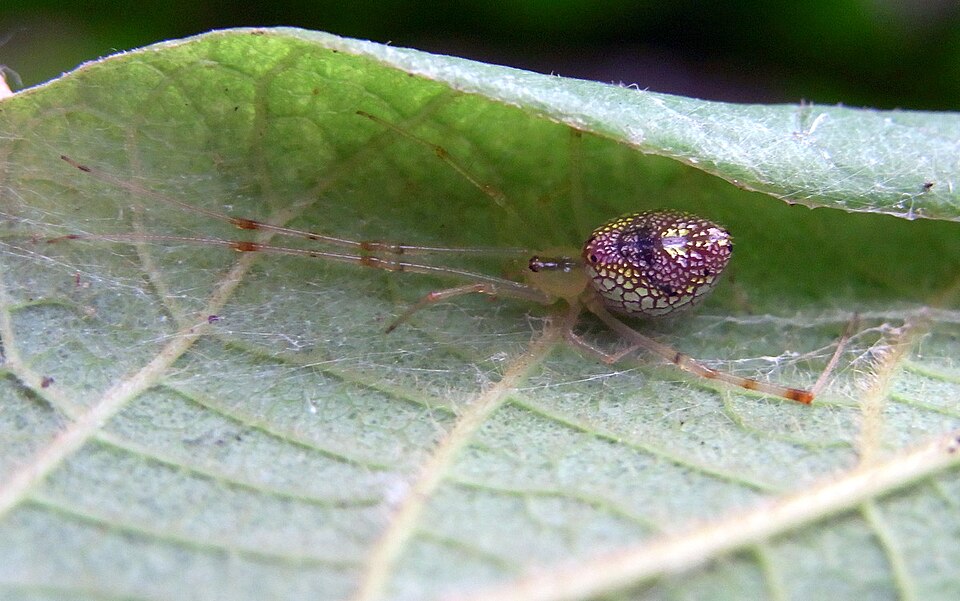
The mirror spider looks like it is covered in tiny shiny mirrors. Its round body has silver patches that sparkle in cream, green, yellow and red. It has long, thin legs.
Fun fact: spiders are not insects. Insects have six legs, spiders have eight. Everyone calls them bugs anyway!
Lives in
All over Australia, most often in Queensland
Length
1.5 to 7 mm (0.06 to 0.28 in)
What does it eat?
It eats small flying insects, especially mosquitoes, flies and gnats.
How big is it?
How long is it?
💅small enough to sit on your fingernail🍽️could run across a dinner table in 3.6 seconds⚡moves 40 times its own body length every second
How big is Mirror spider compared to YOU?
Just maths in your browser. Nothing is saved or sent anywhere.
How fast is it?
A tortoise about 0.3 km/h (0.19 mph)
Mirror spider about 1 km/h (0.62 mph)
A person walking about 5 km/h (3.1 mph)
A kid running fast about 13 km/h (8.1 mph)
cool stuff
Fun facts
1
Its shiny patches can get smaller or bigger when it feels threatened.
2
The mirror patches are made of a shiny material called guanine.
3
One mother spider usually has about 40 spiderlings.
4
It lives for about one year and likes to be on its own.
you asked
Most asked questions about Mirror spider
?What does a mirror spider eat?
Small insects like mosquitoes, flies and gnats.
?Why does the mirror spider shine?
Its body has patches made of guanine that reflect light like little mirrors.
For bug experts
- Scientific name
- Thwaitesia argentiopunctata
- Group
- Spiders
- Family
- Theridiidae
- Classification
- Arachnida > Araneae > Theridiidae
- Lives on
- Australia and Oceania
- Also known as
- Sequinned spider, Twin-peaked Thwaitesia
Where the facts come from
- Thwaitesia argentiopunctata (Wikipedia, CC BY-SA 4.0): what it looks like, where it lives, what it eats, sizes and fun facts, retold in simple words.
- Picture by Poyt448 Peter Woodard. CC BY-SA 3.0, Wikimedia Commons. The round sticker of this bug is cut from the same picture.
If we got something wrong, sorry, we are bug fans, not a science journal. Tell us at [email protected] and we will fix it.
 European garden spider
 Goliath birdeater
 Brown recluse
 Redback spider
 Yellow garden spider
 Bold jumping spider
 Margined calligrapher
 Red-legged grasshopper
 Horse-chestnut leaf miner
 Pill millipede
 Common jezebel
 Mydas fly