

Eyed ladybird
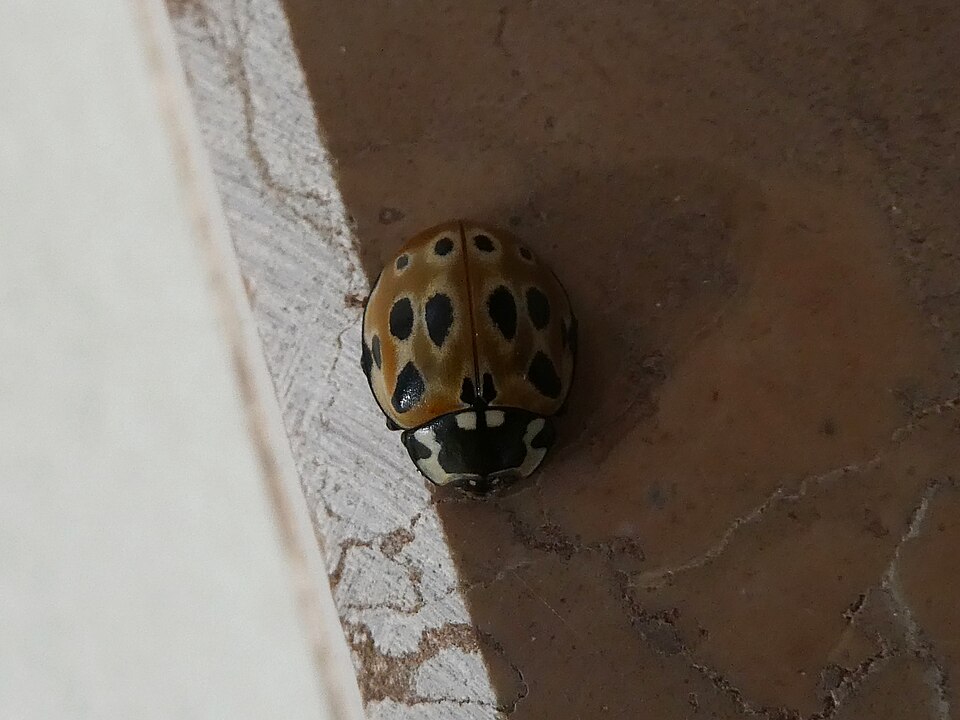
The eyed ladybird is a big ladybird with black spots on a red back. Each black spot has a pale yellow ring around it, so the spots look like little eyes. It lives in pine and spruce forests.
How fast is it?
Fun facts
It can smell pine trees and is drawn to their scent.
It makes a special bitter chemical in its body that keeps enemies from eating it.
The grown-up beetles sleep through the winter.
Some eyed ladybirds have no spots at all, and one found in Scotland had spots joined into long stripes.
In Canada, some have been found with a brown back instead of a red one.
Most asked questions about Eyed ladybird
?Why is it called the eyed ladybird?
Because each black spot has a light ring around it, which makes it look like an eye.
?What does the eyed ladybird eat?
Aphids, especially the ones living on pine trees.
?Is the eyed ladybird dangerous?
No. It is harmless and helps by eating aphids.
For bug experts
- Scientific name
- Anatis ocellata
- Group
- Ladybirds
- Family
- Coccinellidae
- Classification
- Insecta > Coleoptera > Coccinellidae
- Lives on
- Europe, Asia, North America
- Also known as
- Eyed ladybug
Where the facts come from
- Anatis ocellata (Wikipedia, CC BY-SA 4.0): what it looks like, where it lives, what it eats, sizes and fun facts, retold in simple words.
- Picture by Syrio. CC BY-SA 4.0, Wikimedia Commons. The round sticker of this bug is cut from the same picture.
If we got something wrong, sorry, we are bug fans, not a science journal. Tell us at [email protected] and we will fix it.
 Seven-spot ladybird
 Harlequin ladybird
 Mealybug destroyer
 Twenty-two-spot ladybird
 Twice-stabbed ladybird
 Spotted pink ladybird
 Birch sawfly
 Asian bush mosquito
 Spruce beetle
 Tulip-tree beauty
 Chequered skipper
 Flat-backed millipede