

Twice-stabbed ladybird
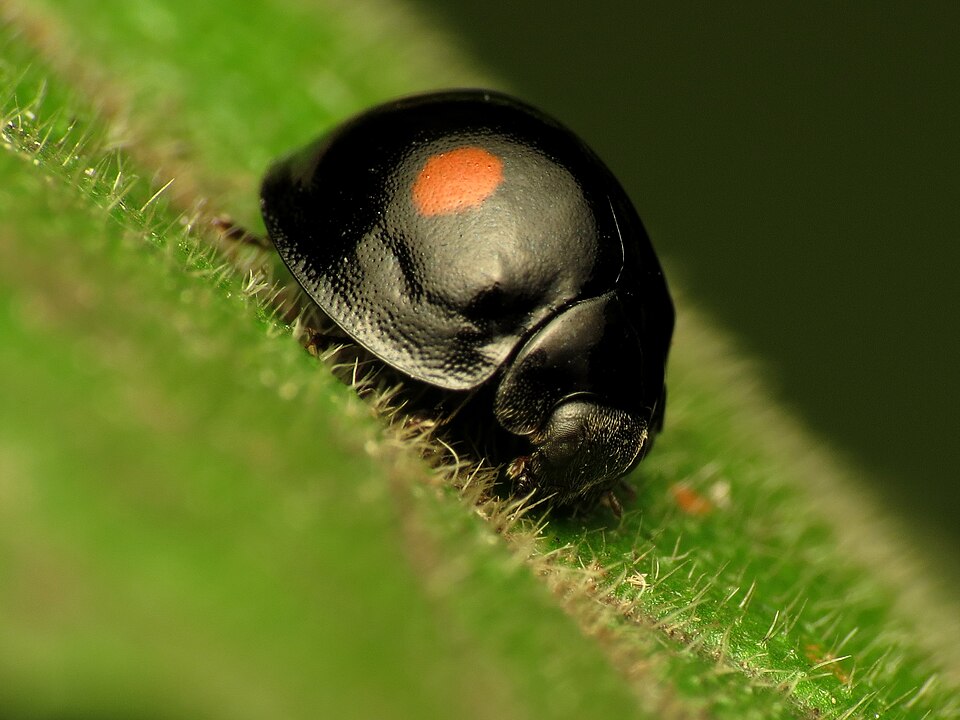
The twice-stabbed ladybird is shiny black with just one red spot on each wing case. It looks like a tiny black helmet with two red dots. It is a hungry helper that eats pests on trees.
How fast is it?
Fun facts
It is a big help in orchards and orange groves, where it eats pests on the trees.
It helps protect hemlock trees from a scale insect that came from far away and harms them.
Under its black back, its tummy is yellow or red.
In winter it hides in fallen leaves on the ground.
Bug sprays harm it, so gardeners are asked to use gentler ways to fight pests.
Most asked questions about Twice-stabbed ladybird
?Is the twice-stabbed ladybird a ladybird?
Yes. It is a real ladybird, just black with two red spots instead of red with black spots.
?What does the twice-stabbed ladybird eat?
Scale insects, aphids and mealybugs that live on trees and plants.
For bug experts
- Scientific name
- Chilocorus stigma
- Group
- Ladybirds
- Family
- Coccinellidae
- Classification
- Insecta > Coleoptera > Coccinellidae
- Lives on
- North America, Australia and Oceania
- Also known as
- Twice-stabbed ladybug
Where the facts come from
- Chilocorus stigma (Wikipedia, CC BY-SA 4.0): what it looks like, where it lives, what it eats, sizes and fun facts, retold in simple words.
- Picture by Katja Schulz from Washington, D. C., USA. CC BY 2.0, Wikimedia Commons. The round sticker of this bug is cut from the same picture.
If we got something wrong, sorry, we are bug fans, not a science journal. Tell us at [email protected] and we will fix it.
 Seven-spot ladybird
 Harlequin ladybird
 Mealybug destroyer
 Twenty-two-spot ladybird
 Spotted pink ladybird
 Steelblue ladybird
 Cinnabar moth
 Red admiral
 Rabid wolf spider
 German wasp
 Colorado potato beetle
 Tobacco hornworm
.jpg)