

Duke of Burgundy
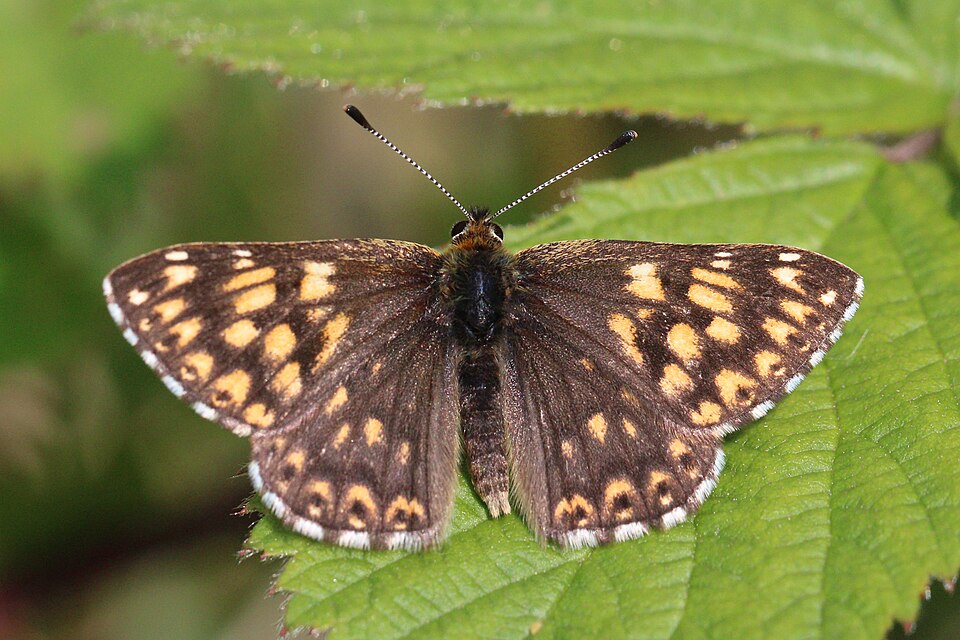
The Duke of Burgundy is a small butterfly with orange and brown wings in a chequered pattern, like a tiny chessboard. It has a grand royal name, but nobody knows where the name came from. It is the only butterfly of its family in all of Europe.
How big is it?
How wide are its wings?
How big is Duke of Burgundy compared to YOU?
Just maths in your browser. Nothing is saved or sent anywhere.
How fast is it?
Fun facts
The boys guard their own little warm sunny spot and have wild chasing fights in the air with other boys.
The girls like to wander and can fly a long way to find new places to live.
Its tiny round eggs are pale green and get a dark purple blotch just before they hatch.
It stays a pupa for about nine months, much longer than most butterflies.
In Britain it nearly disappeared, but people looked after its meadows and now there are many more again.
Most asked questions about Duke of Burgundy
?Why is it called the Duke of Burgundy?
Nobody knows for sure where the name came from. It was once called Mr Vernon's small fritillary.
?What does the Duke of Burgundy caterpillar eat?
Mostly the leaves of cowslips and primroses.
?How big is the Duke of Burgundy butterfly?
Its wings are about 29 to 34 millimetres across. The girls are a little bigger than the boys.
For bug experts
- Scientific name
- Hamearis lucina
- Group
- Butterflies
- Family
- Riodinidae
- Classification
- Insecta > Lepidoptera > Riodinidae
- Lives on
- Europe
- Also known as
- Duke of Burgundy fritillary, Mr Vernon's small fritillary
Where the facts come from
- Hamearis lucina (Wikipedia, CC BY-SA 4.0): what it looks like, where it lives, what it eats, sizes and fun facts, retold in simple words.
- Picture by Charles J. Sharp. CC BY-SA 4.0, Wikimedia Commons. The round sticker of this bug is cut from the same picture.
If we got something wrong, sorry, we are bug fans, not a science journal. Tell us at [email protected] and we will fix it.
 Monarch butterfly
 Peacock butterfly
 Blue morpho
 Old World swallowtail
 Small white
 Eastern tiger swallowtail
 Tawny crazy ant
 Snowberry clearwing
 Brown-tail moth
 Common red soldier beetle
 Dark giant horsefly
 Orchard spider
_male.jpg)