

Big-headed ant
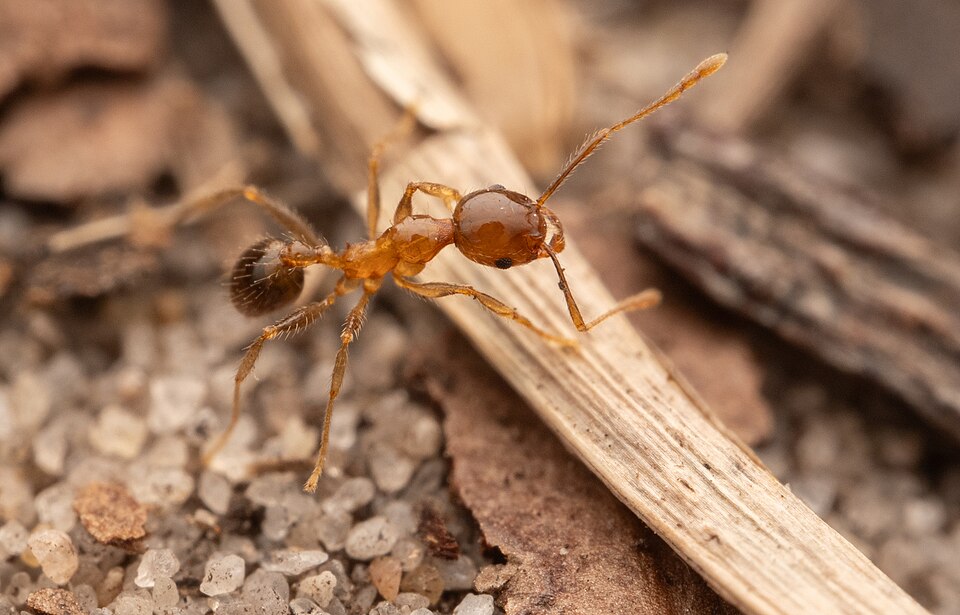
The big-headed ant is a small brown ant from Africa. Some of its workers have a huge head, much too big for their body. They use their strong jaws to crack seeds and cut food into pieces for the smaller workers to carry home.
How big is it?
How long is it?
How big is Big-headed ant compared to YOU?
Just maths in your browser. Nothing is saved or sent anywhere.
How fast is it?
Fun facts
The big-headed workers are about 4 millimetres long, twice as long as the small workers.
Each queen can lay up to 290 eggs a month.
It is one of the worst invasive ants in the world, because it takes over places where it does not belong.
It sometimes chews on telephone cables and electric wires.
It protects aphids and other sap-sucking bugs, because they give it sweet honeydew.
Most asked questions about Big-headed ant
?Why is it called the big-headed ant?
Because some of its workers have a huge head with strong jaws for cracking seeds.
?What does the big-headed ant eat?
Dead insects, small animals, seeds and sweet honeydew from aphids.
For bug experts
- Scientific name
- Pheidole megacephala
- Named by
- Fabricius, 1793
- Group
- Ants
- Family
- Formicidae
- Classification
- Insecta > Hymenoptera > Formicidae
- Lives on
- Africa, Asia, North America, South America, Australia and Oceania
- Also known as
- Coastal brown ant
Where the facts come from
- Pheidole megacephala (Wikipedia, CC BY-SA 4.0): what it looks like, where it lives, what it eats, sizes and fun facts, retold in simple words.
- Picture by Philipp Hoenle. CC0, Wikimedia Commons. The round sticker of this bug is cut from the same picture.
If we got something wrong, sorry, we are bug fans, not a science journal. Tell us at [email protected] and we will fix it.
 Black garden ant
 Bullet ant
 Pharaoh ant
 Argentine ant
 Red imported fire ant
 Yellow crazy ant
 Box tree moth
 Carolina mantis
 European paper wasp
 Scarlet lily beetle
 Australian plague locust
 American nursery web spider