

Ashy mining bee
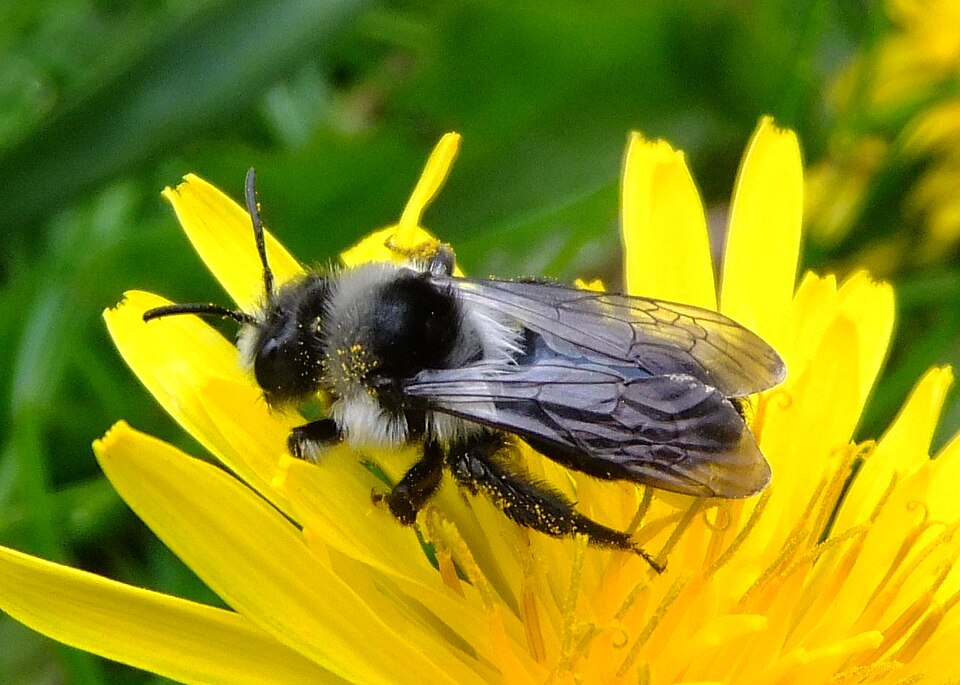
The ashy mining bee is a black bee with fluffy grey hair, which makes it look as if it rolled in ashes. It is a gentle bee that lives alone, not in a hive. Each mother digs her own little burrow in the ground, often in lawns and flowerbeds.
How fast is it?
Fun facts
You can find its nest by the little volcano of soil it piles up around the hole.
Inside the burrow there are several little rooms. The mother fills each one with nectar and pollen and lays one egg in it.
It is an important helper for fruit trees, flying in spring when they are in bloom.
Sneaky cuckoo bees often creep into its nest to lay their own eggs there.
Most asked questions about Ashy mining bee
?What are the little mounds of soil on my lawn?
In spring they may be the nests of ashy mining bees. Each mound has a burrow underneath.
?Do ashy mining bees live in a hive?
No. Each female digs and looks after her own nest, so they are called solitary bees.
For bug experts
- Scientific name
- Andrena cineraria
- Named by
- Linnaeus, 1758
- Group
- Bees and bumblebees
- Family
- Andrenidae
- Classification
- Insecta > Hymenoptera > Andrenidae
- Lives on
- Europe
- Also known as
- Danubian miner, Grey mining bee
Where the facts come from
- Ashy mining bee (Wikipedia, CC BY-SA 4.0): what it looks like, where it lives, what it eats, sizes and fun facts, retold in simple words.
- Picture by orangeaurochs. CC BY 2.0, Wikimedia Commons. The round sticker of this bug is cut from the same picture.
If we got something wrong, sorry, we are bug fans, not a science journal. Tell us at [email protected] and we will fix it.
 Western honey bee
 Buff-tailed bumblebee
 Violet carpenter bee
 Giant honey bee
 Wallace's giant bee
 Himalayan giant honey bee
 Grey hairstreak
 Eastern harvestman
 Japanese giant mantis
 Grey field slug
 Fall field cricket
 Common garden katydid