

Magpie moth
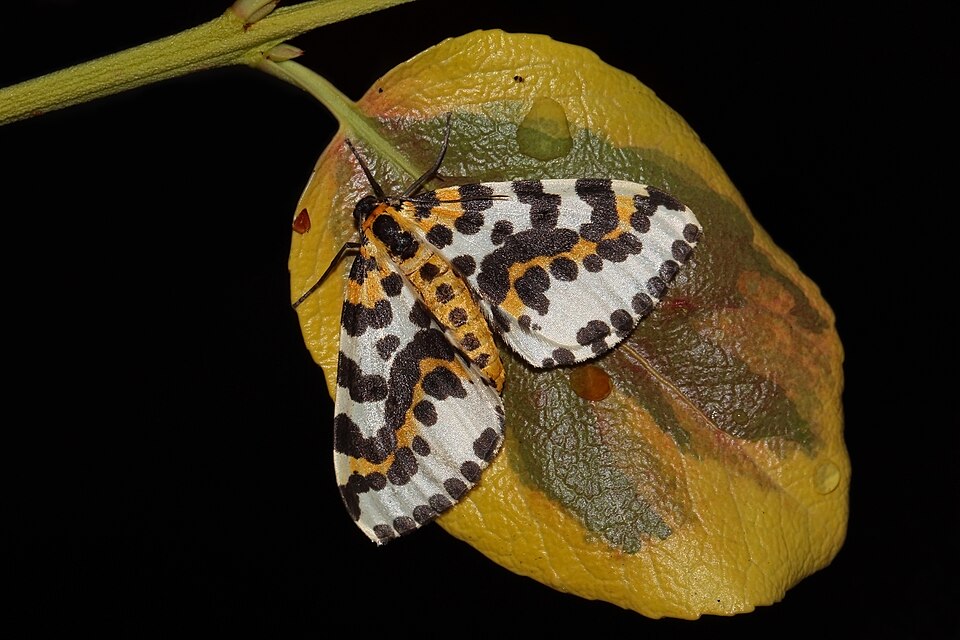
The magpie moth is a white moth covered in black spots, with yellow bands across its front wings. It looks like it has been splashed with ink. Its caterpillar has the same black, white and yellow colours.
How fast is it?
Fun facts
Each front wing is about 2 centimetres long.
No two magpie moths look quite the same. There are many different forms of it.
Studying this moth helped scientists discover that some features are passed on differently to boys and girls.
The caterpillar wears the same black, white and yellow colours as the grown-up moth.
Most asked questions about Magpie moth
?What does the magpie moth caterpillar eat?
Leaves of berry bushes like gooseberry and currants, and also hawthorn, hazel and willow.
?Why is it called a magpie moth?
Because its black and white speckles look like a magpie's feathers.
?Is the magpie moth harmful?
Not to people. Its caterpillars can eat the leaves of gooseberry and currant bushes.
For bug experts
- Scientific name
- Abraxas grossulariata
- Named by
- Linnaeus, 1758
- Group
- Moths
- Family
- Geometridae
- Classification
- Insecta > Lepidoptera > Geometridae
- Lives on
- Europe, Asia, North America
Where the facts come from
- Abraxas grossulariata (Wikipedia, CC BY-SA 4.0): what it looks like, where it lives, what it eats, sizes and fun facts, retold in simple words.
- Picture by Charles J. Sharp. CC BY-SA 4.0, Wikimedia Commons. The round sticker of this bug is cut from the same picture.
If we got something wrong, sorry, we are bug fans, not a science journal. Tell us at [email protected] and we will fix it.
 Atlas moth
 Luna moth
 Hummingbird hawk-moth
 Domestic silk moth
 Isabella tiger moth
 Polyphemus moth
 Plague soldier beetle
 Franklin's bumblebee
 Magnetic termite
 High brown fritillary
 Raspberry beetle
 Painted woodlouse
.jpg)