

Jack jumper ant
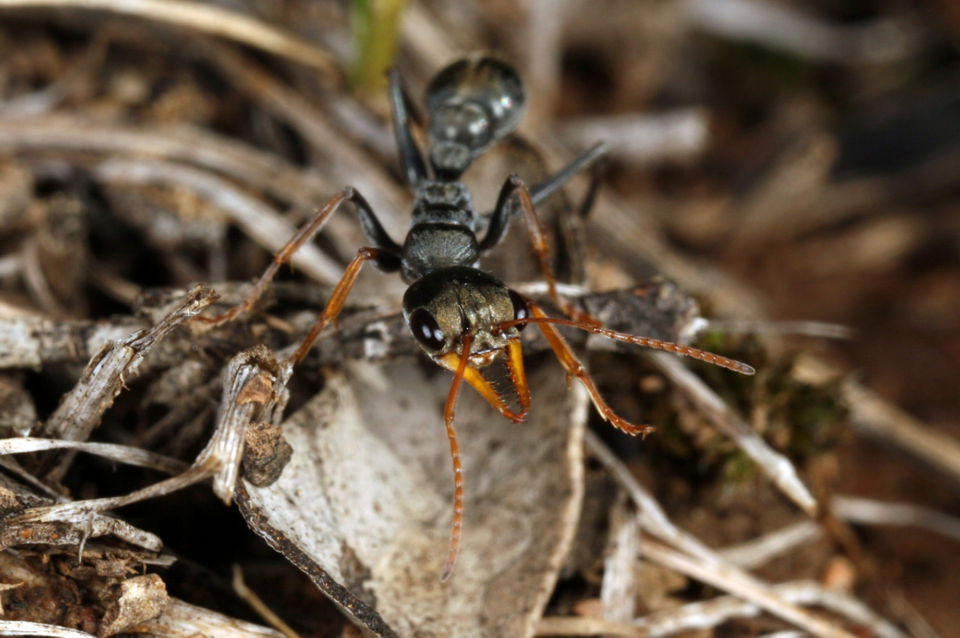
The jack jumper ant is a big Australian ant that can jump. It is black or dark red, with yellow or orange legs and big jaws. When it gets upset or is hunting, it hops along in little leaps.
How big is it?
How long is it?
How big is Jack jumper ant compared to YOU?
Just maths in your browser. Nothing is saved or sent anywhere.
How fast is it?
Fun facts
It is named after the jumping-jack firecracker, because of the way it jumps around.
The workers can lay eggs and start a family even when there is no queen.
It has only one pair of chromosomes, the tiny instruction packs inside every cell. Most animals have many more.
A worker ant can live for more than one year.
Most asked questions about Jack jumper ant
?Can jack jumper ants really jump?
Yes. When they are upset or looking for food, they hop and leap, which gave them their name.
?Where do jack jumper ants live?
In Australia, mostly in Tasmania and the southeast, in bush and dry forests.
For bug experts
- Scientific name
- Myrmecia pilosula
- Named by
- Smith, 1858
- Group
- Ants
- Family
- Formicidae
- Classification
- Insecta > Hymenoptera > Formicidae
- Lives on
- Australia and Oceania
- Also known as
- Jack jumper, Jumping jack, Hopper ant, Jumper ant
Where the facts come from
- Jack jumper ant (Wikipedia, CC BY-SA 4.0): what it looks like, where it lives, what it eats, sizes and fun facts, retold in simple words.
- Picture by Steve Shattuck. CC BY 2.0, Wikimedia Commons. The round sticker of this bug is cut from the same picture.
If we got something wrong, sorry, we are bug fans, not a science journal. Tell us at [email protected] and we will fix it.
 Black garden ant
 Bullet ant
 Pharaoh ant
 Argentine ant
 Red imported fire ant
 Yellow crazy ant
 Stag beetle
 Luna moth
 Northern giant hornet
 Western conifer seed bug
 Rosy maple moth
 Dark fishing spider