

Bug card No. 0540 of 1,500
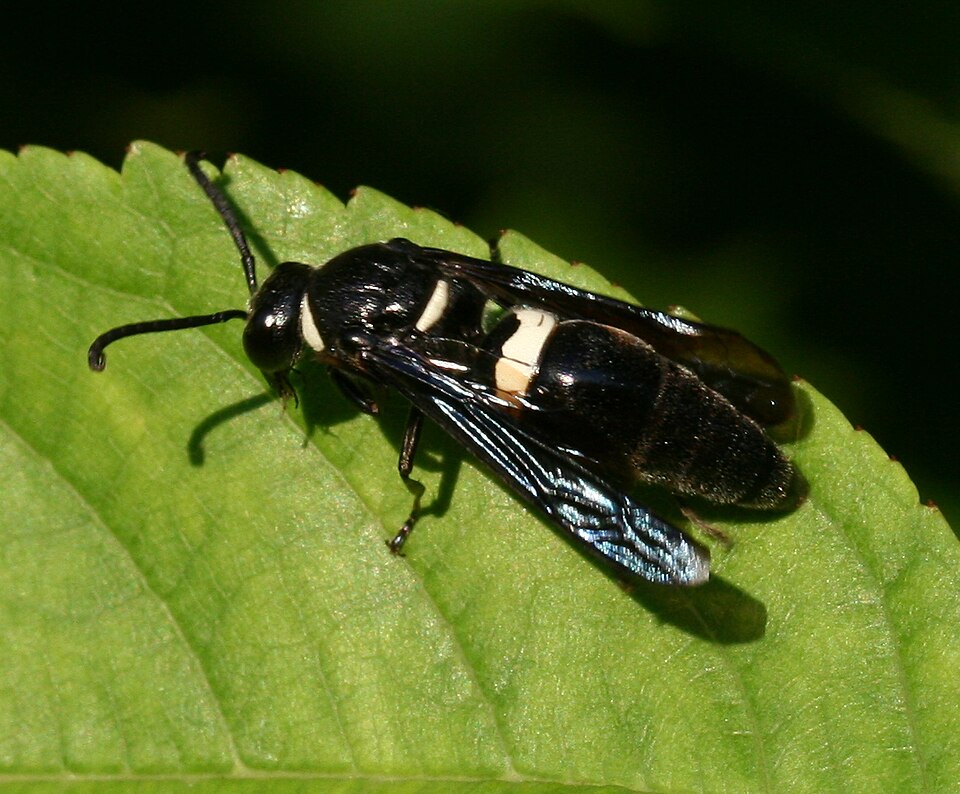
Four-toothed mason wasp
Monobia quadridens
Name means: “quadridens means four teeth”
The four-toothed mason wasp is a black wasp with one wide ivory-white band near the top of its tummy. It lives alone, not in a big nest with other wasps. It moves into old holes and hollow stems to raise its babies.
Lives in
Eastern North America, from Canada to north-eastern Mexico, in gardens and fields
Wingspan
1.1 to 1.8 cm (0.43 to 0.71 in)
females are bigger than malesWhat does it eat?
It catches small caterpillars for its babies and also eats lots of pollen.
How big is it?
How wide are its wings?
⚽could fly across a whole football pitch in 16 seconds
How big is Four-toothed mason wasp compared to YOU?
Just maths in your browser. Nothing is saved or sent anywhere.
How fast is it?
A kid running fast about 13 km/h (8.1 mph)
Four-toothed mason wasp about 23 km/h (14 mph)
A grown-up on a bike about 25 km/h (16 mph)
A car driving in town about 50 km/h (31 mph)
cool stuff
Fun facts
1
It nests in old carpenter bee tunnels, old mud dauber nests and hollow plant stems.
2
It has two families each year, and one waits through the winter as pupae.
3
It was first described by Carl Linnaeus back in 1763.
you asked
Most asked questions about Four-toothed mason wasp
?What does the four-toothed mason wasp eat?
Small caterpillars, which it brings to its babies, and pollen.
For bug experts
- Scientific name
- Monobia quadridens
- Named by
- Linnaeus, 1763
- Group
- Wasps and hornets
- Family
- Vespidae
- Classification
- Insecta > Hymenoptera > Vespidae
- Lives on
- North America
Where the facts come from
- Monobia quadridens (Wikipedia, CC BY-SA 4.0): what it looks like, where it lives, what it eats, sizes and fun facts, retold in simple words.
- Picture by Sandy Rae. CC BY-SA 3.0, Wikimedia Commons. The round sticker of this bug is cut from the same picture.
If we got something wrong, sorry, we are bug fans, not a science journal. Tell us at [email protected] and we will fix it.
 European hornet
 Northern giant hornet
 Bald-faced hornet
 Red velvet ant
 Eastern cicada killer
 Asian hornet
 Common earwig
 Hummingbird hawk-moth
 Yellow garden spider
 Isabella tiger moth
 Boxelder bug
 Joro spider