

Bug card No. 1131 of 1,500
Red velvet ant
Dasymutilla occidentalis
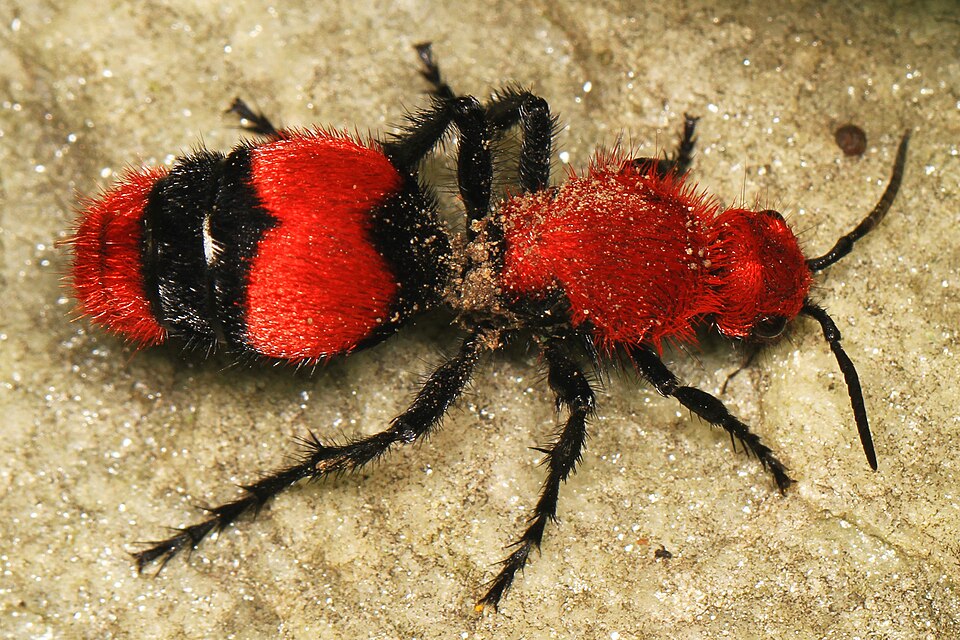
The red velvet ant is fuzzy, bright red and black, and looks like a big hairy ant. But it is really a wasp. The females have no wings and run around fast on the ground.
Lives in
The eastern United States, mostly seen in summer
Length
1.9 cm (0.75 in)
What does it eat?
Its larva lives on the babies of other wasps. The mother sneaks into another wasp's nest and lays an egg on a baby wasp, and her own grub eats it.
How big is it?
How long is it?
🍚as long as 3 grains of rice in a row⚽could fly across a whole football pitch in 16 seconds⚡moves 350 times its own body length every second
How big is Red velvet ant compared to YOU?
Just maths in your browser. Nothing is saved or sent anywhere.
How fast is it?
A kid running fast about 13 km/h (8.1 mph)
Red velvet ant about 24 km/h (15 mph)
A grown-up on a bike about 25 km/h (16 mph)
A car driving in town about 50 km/h (31 mph)
cool stuff
Fun facts
1
It can squeak. It rubs parts of its body together to make the sound and scare enemies away.
you asked
Most asked questions about Red velvet ant
?Is a red velvet ant really an ant?
No. It is a wasp. The females have no wings, so they look like big fuzzy ants.
?How big is a red velvet ant?
It is about 19 millimetres long, the biggest velvet ant in the eastern United States.
Myth buster
Myth: A velvet ant is an ant.
Truth: No. It is a wasp. The females have no wings, so people mix them up with ants.
For bug experts
- Scientific name
- Dasymutilla occidentalis
- Group
- Wasps and hornets
- Family
- Mutillidae
- Classification
- Insecta > Hymenoptera > Mutillidae
- Lives on
- North America
- Also known as
- Eastern velvet ant, Cow ant, Cow killer
Where the facts come from
- Dasymutilla occidentalis (Wikipedia, CC BY-SA 4.0): what it looks like, where it lives, what it eats, sizes and fun facts, retold in simple words.
- Picture by Judy Gallagher. CC BY 2.0, Wikimedia Commons. The round sticker of this bug is cut from the same picture.
If we got something wrong, sorry, we are bug fans, not a science journal. Tell us at [email protected] and we will fix it.
 European hornet
 Northern giant hornet
 Bald-faced hornet
 Eastern cicada killer
 Asian hornet
 Great black wasp
 Spring azure
 Mediterranean mantis
 Fork-tailed bush katydid
 Giant grasshopper
 Hairy-footed flower bee
 Fiery skipper
.jpg)