

European beewolf
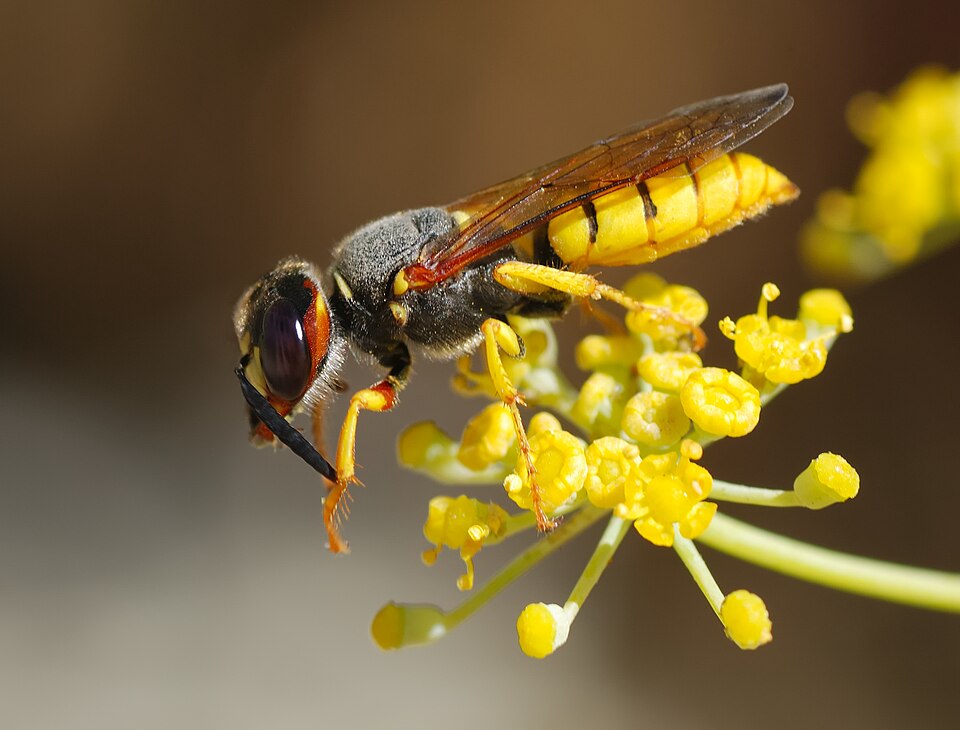
The European beewolf is a yellow and black wasp that lives alone, not in a big nest. The grown-ups drink nectar, but the mother is a bee hunter. She catches honey bees to feed her babies.
How fast is it?
Fun facts
She digs a tunnel in the sand up to a metre long, with many little rooms at the end. Each room gets an egg and one to five bees.
One female can catch up to 100 bees in a summer.
Many beewolves dig their nests close together. One group had as many as 15000 tunnels.
The males have a pattern between their eyes shaped like a fork with three prongs.
Most asked questions about European beewolf
?Why is it called a beewolf?
Because the female hunts honey bees, like a wolf hunting its prey.
?What does the European beewolf eat?
The grown-ups eat nectar and pollen. Their larvae eat the bees their mother brings.
For bug experts
- Scientific name
- Philanthus triangulum
- Named by
- Fabricius, 1775
- Group
- Wasps and hornets
- Family
- Crabronidae
- Classification
- Insecta > Hymenoptera > Crabronidae
- Lives on
- Europe, Africa, Asia
- Also known as
- Bee-killer wasp, Bee-eating philanthus
Where the facts come from
- European beewolf (Wikipedia, CC BY-SA 4.0): what it looks like, where it lives, what it eats, sizes and fun facts, retold in simple words.
- Picture by Alvesgaspar. CC BY-SA 3.0, Wikimedia Commons. The round sticker of this bug is cut from the same picture.
If we got something wrong, sorry, we are bug fans, not a science journal. Tell us at [email protected] and we will fix it.
 European hornet
 Northern giant hornet
 Bald-faced hornet
 Red velvet ant
 Eastern cicada killer
 Asian hornet
 Nine-spotted moth
 Western pygmy blue
 Alkali bee
 Two-tailed pasha
 Stripe-tailed scorpion
 Fog-basking beetle