

Comma butterfly
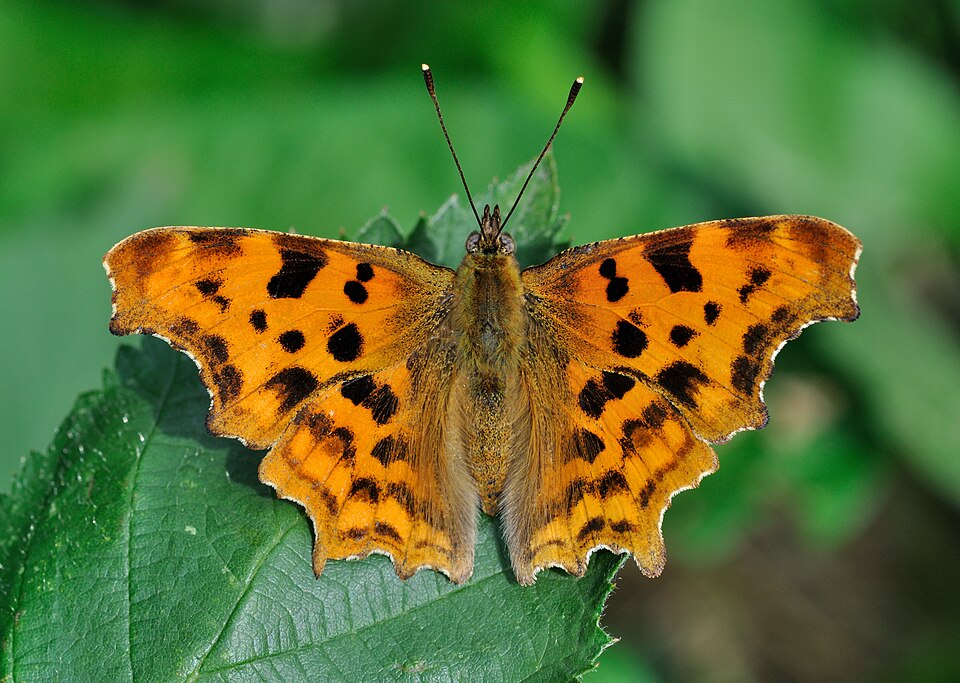
The comma butterfly is bright orange with dark brown spots, and the edges of its wings are ragged and jagged, as if someone cut them with zigzag scissors. When it folds its wings it looks just like a dead brown leaf. Under its back wing there is a tiny white mark shaped like a comma.
How fast is it?
Fun facts
Its caterpillar looks like a bird dropping, so birds do not want to eat it.
Its chrysalis looks like a shrivelled leaf.
Older caterpillars grow strong spines along their backs.
Butterflies from early summer are lighter orange than the ones that fly later in the year.
It is a strong flier and is spreading to new places as the climate warms.
Most asked questions about Comma butterfly
?Why is it called the comma butterfly?
Because under its back wing there is a small white mark shaped like a comma.
?What does the comma caterpillar eat?
Many plants, but stinging nettle is its favourite. It also eats elm, willow, gooseberry and birch leaves.
For bug experts
- Scientific name
- Polygonia c-album
- Group
- Butterflies
- Family
- Nymphalidae
- Classification
- Insecta > Lepidoptera > Nymphalidae
- Lives on
- Europe, Africa, Asia
- Also known as
- Comma
Where the facts come from
- Polygonia c-album (Wikipedia, CC BY-SA 4.0): what it looks like, where it lives, what it eats, sizes and fun facts, retold in simple words.
- Picture by Quartl. CC BY-SA 3.0, Wikimedia Commons. The round sticker of this bug is cut from the same picture.
If we got something wrong, sorry, we are bug fans, not a science journal. Tell us at [email protected] and we will fix it.
 Monarch butterfly
 Peacock butterfly
 Blue morpho
 Old World swallowtail
 Small white
 Eastern tiger swallowtail
 Yellow earth centipede
 Blood-red ant
 Black firefly
 Forest cockchafer
 Musk beetle
 Tanner beetle