

Blue-tailed damselfly
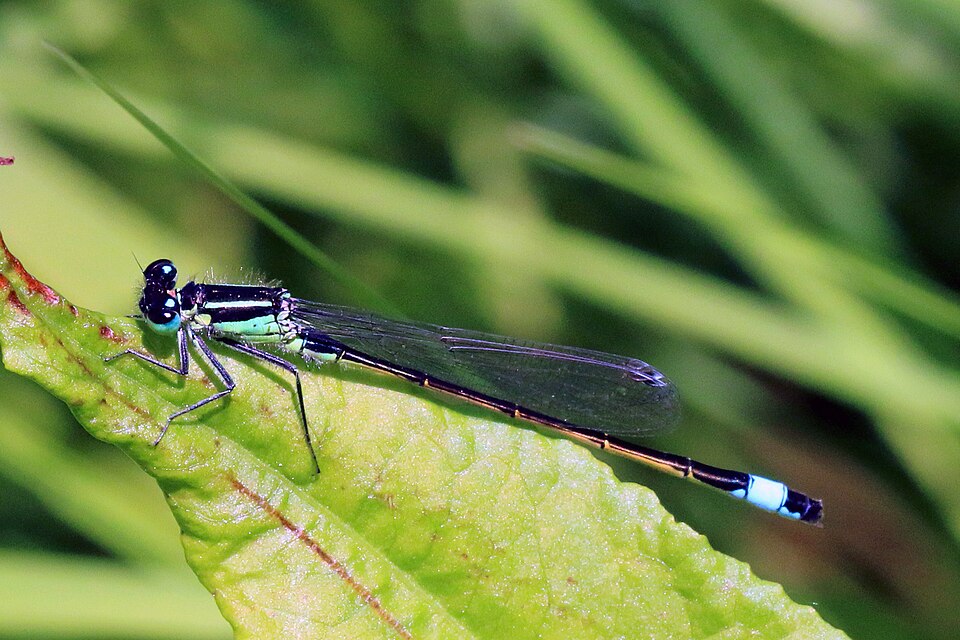
The blue-tailed damselfly is a thin, dark little damselfly with a bright blue spot near the end of its tail, like a tiny light. It flutters around ponds and slow rivers. When it rests, it folds its wings together over its back.
How big is it?
How long is it?
How wide are its wings?
How big is Blue-tailed damselfly compared to YOU?
Just maths in your browser. Nothing is saved or sent anywhere.
How fast is it?
Fun facts
The females come in many colours: pink, violet, green, blue or brown. Their colour changes as they grow older.
Some females are coloured just like the males, so the males leave them in peace.
It is a super flier that can steer each of its four wings on its own.
Scientists found it can still fly and catch food even after losing a whole wing.
The female lays her eggs on floating bits of water plants.
Most asked questions about Blue-tailed damselfly
?What is the difference between a damselfly and a dragonfly?
A damselfly is thinner and folds its wings together over its back when it rests. A dragonfly keeps its wings spread out flat.
?Is the blue-tailed damselfly dangerous?
No. It cannot sting and does not bite people.
?What does the blue-tailed damselfly eat?
Small flying insects, which it catches in the air or picks off leaves.
For bug experts
- Scientific name
- Ischnura elegans
- Named by
- Vander Linden, 1820
- Group
- Dragonflies and damselflies
- Family
- Coenagrionidae
- Classification
- Insecta > Odonata > Coenagrionidae
- Lives on
- Europe, Asia
- Also known as
- Common bluetail
Where the facts come from
- Blue-tailed damselfly (Wikipedia, CC BY-SA 4.0): what it looks like, where it lives, what it eats, sizes and fun facts, retold in simple words.
- Picture by Charles J. Sharp. CC BY-SA 3.0, Wikimedia Commons. The round sticker of this bug is cut from the same picture.
If we got something wrong, sorry, we are bug fans, not a science journal. Tell us at [email protected] and we will fix it.
 Emperor dragonfly
 Common whitetail
 Green darner
 Ebony jewelwing
 Globe skimmer
 Blue dasher
 Six-spotted fishing spider
 Two-tailed swallowtail
 Inland floodwater mosquito
 Phantom midge
 March brown
 Giant dobsonfly
_male_adult.jpg)