

Pharaoh cicada
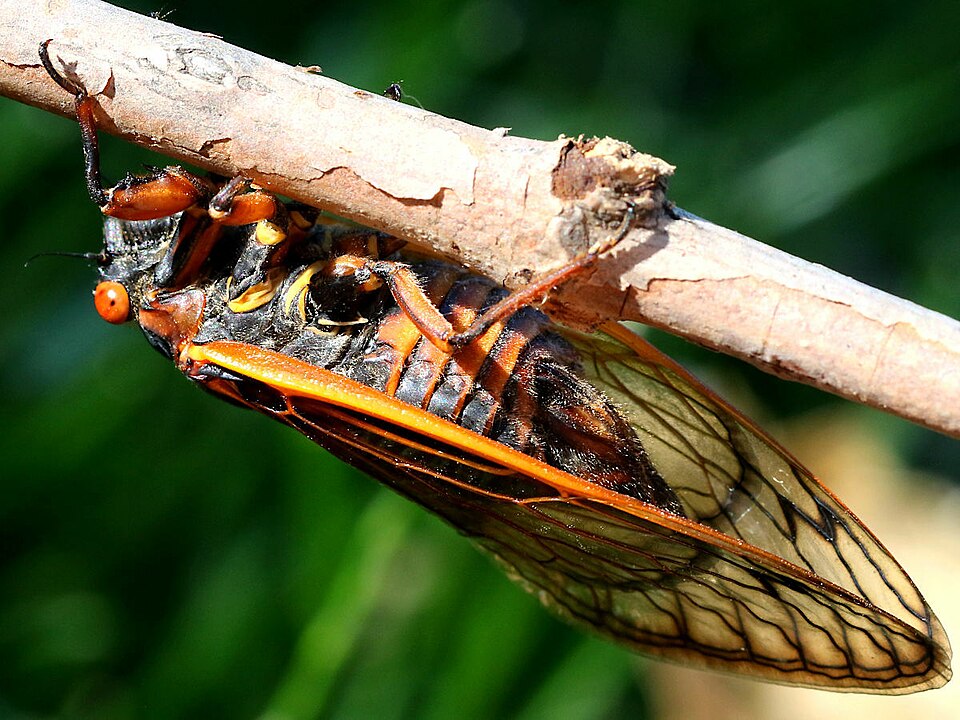
The Pharaoh cicada is a black insect with red eyes, reddish wing veins and orange stripes on its belly. It spends about 17 years hiding underground as a baby. Then, all at once, huge numbers of them climb out and fill the trees with their loud song.
How fast is it?
Fun facts
Its song is said to sound like someone calling "weeeee-whoa" or "Pharaoh". That is how it got its name.
It is the biggest of the periodical cicadas, the ones that come out together after many years underground.
Mothers lay their eggs in small twigs. The babies hatch, drop to the ground and dig in.
One old report says the babies were found 3 metres below the ground.
People in America wrote about the great cicada years almost 300 years ago, and Benjamin Franklin was one of them.
Most asked questions about Pharaoh cicada
?How often do Pharaoh cicadas come out?
About every 17 years. In between, they live underground and you almost never see them.
?Are Pharaoh cicadas dangerous?
No. They are very noisy but do not bite or sting people.
?What do cicadas eat?
They drink plant sap. The young ones suck sap from tree roots underground.
Myth buster
Myth: The Pharaoh cicada is a kind of locust.
Truth: No. People often call it the 17-year locust, but it is a cicada. Real locusts are a kind of grasshopper.
For bug experts
- Scientific name
- Magicicada septendecim
- Named by
- Linnaeus, 1758
- Group
- True bugs and cicadas
- Family
- Cicadidae
- Classification
- Insecta > Hemiptera > Cicadidae
- Lives on
- North America
- Also known as
- 17-year locust
Where the facts come from
- Magicicada septendecim (Wikipedia, CC BY-SA 4.0): what it looks like, where it lives, what it eats, sizes and fun facts, retold in simple words.
- Picture by peterwchen. CC BY 4.0, Wikimedia Commons. The round sticker of this bug is cut from the same picture.
If we got something wrong, sorry, we are bug fans, not a science journal. Tell us at [email protected] and we will fix it.
 Spotted lanternfly
 Brown marmorated stink bug
 Cochineal
 Boxelder bug
 Western conifer seed bug
 Wheel bug
 Cottonwood borer
 Mocker swallowtail
 Eastern red centipede
 Southern giant hornet
 Reindeer warble fly
 Red-headed ash borer