

Malaysian trumpet snail
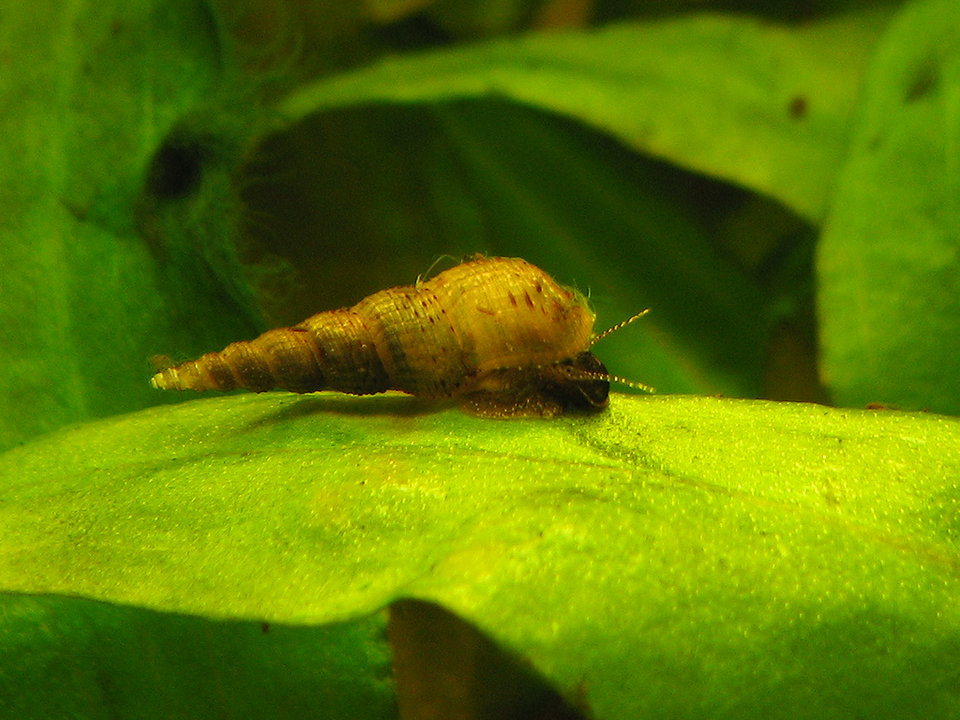
The Malaysian trumpet snail is a small water snail with a long, pointy shell like a little ice cream cone. The shell is light brown with rusty red spots. It has a tiny lid that it can shut like a door when it hides inside.
How big is it?
How long is it?
How big is Malaysian trumpet snail compared to YOU?
Just maths in your browser. Nothing is saved or sent anywhere.
How fast is it?
Fun facts
It likes to dig into the sand and mud and is busiest at night.
Most of these snails are mothers. They can have babies without any father at all.
The babies grow inside a pouch in the mother's body and come out as tiny snails, not as eggs. One mother can have more than 70 babies.
In some lakes its shell is very dark, so it can hide on the black rocks there.
It got carried around the world in fish tanks. In one river in Florida, people counted 10,000 of them on a single square metre.
Most asked questions about Malaysian trumpet snail
?What does a Malaysian trumpet snail eat?
Tiny algae and bits of old plants and leftovers. That is why fish tank owners often find it cleaning the sand.
?How big does a Malaysian trumpet snail get?
Its shell is usually 2 to 3.5 centimetres long. A few rare ones grow up to 8 centimetres.
?Is the Malaysian trumpet snail harmful?
Not to people. But where it was brought in by mistake, it can crowd out the snails that lived there before.
For bug experts
- Scientific name
- Melanoides tuberculata
- Named by
- O. F. Müller, 1774
- Group
- Snails, slugs and worms
- Family
- Thiaridae
- Classification
- Gastropoda > Thiaridae
- Lives on
- Africa, Asia, North America, South America, Europe, Australia and Oceania
- Also known as
- Red-rimmed melania, Malayan livebearing snail
Where the facts come from
- Red-rimmed melania (Wikipedia, CC BY-SA 4.0): what it looks like, where it lives, what it eats, sizes and fun facts, retold in simple words.
- Picture by Dennis L.. CC BY 2.0, Wikimedia Commons. The round sticker of this bug is cut from the same picture.
If we got something wrong, sorry, we are bug fans, not a science journal. Tell us at [email protected] and we will fix it.
 Garden snail
 Giant African land snail
 Leopard slug
 Bladder snail
 Medicinal leech
 Common earthworm
 Fen raft spider
 Sea skater
 Black fly
 Water louse
 Flame skimmer
 Beautiful demoiselle