

Lackey moth
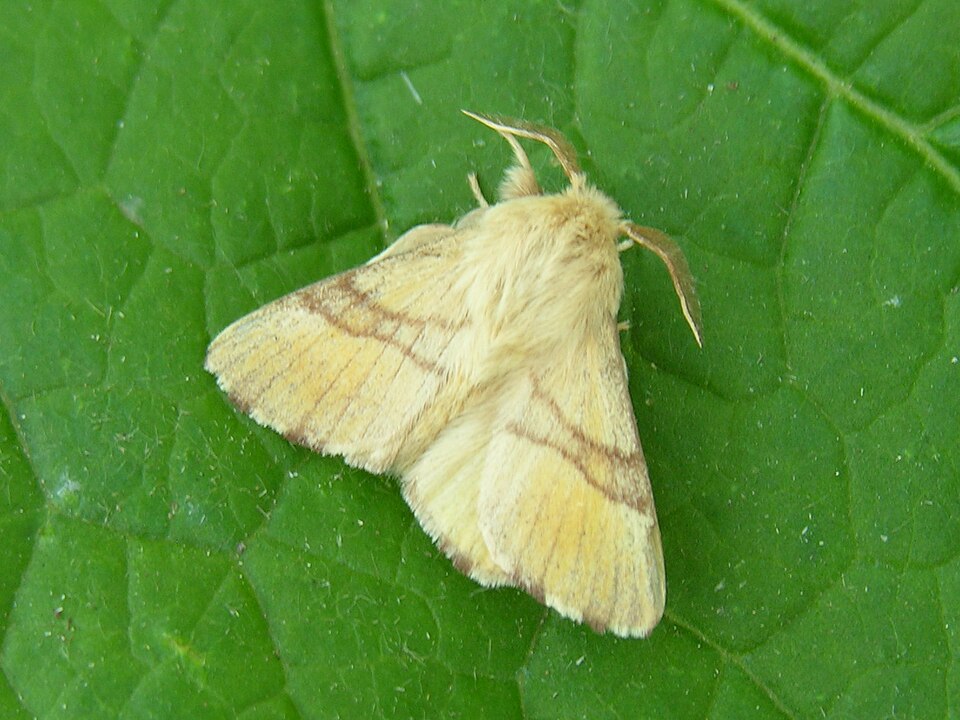
The lackey moth is a plain brown moth, but its caterpillars are a real show. They are striped with blue, orange and white. The caterpillars live together and spin a silky tent on a tree to stay warm.
How fast is it?
Fun facts
The mother lays her eggs in a neat ring wrapped around a twig, like a tiny bracelet.
The eggs stay on the twig all winter and hatch in spring.
The silk tent helps the caterpillars keep the right temperature.
When a caterpillar is ready to change, it drops to the ground and makes its cocoon between leaves.
The grown-up moths fly from June to August.
Most asked questions about Lackey moth
?What do lackey moth caterpillars look like?
They are brown with blue, orange and white stripes, and they live together in a silk tent.
?What do lackey moth caterpillars eat?
Young leaves of fruit trees, willow, oak and other trees and bushes.
?Is the lackey moth harmful?
It is harmless to people. Lots of caterpillars can eat many leaves on a tree.
For bug experts
- Scientific name
- Malacosoma neustria
- Named by
- Linnaeus, 1758
- Group
- Moths
- Family
- Lasiocampidae
- Classification
- Insecta > Lepidoptera > Lasiocampidae
- Lives on
- Europe, Asia, Africa
Where the facts come from
- Lackey moth (Wikipedia, CC BY-SA 4.0): what it looks like, where it lives, what it eats, sizes and fun facts, retold in simple words.
- Picture by unknown author. Public domain, Wikimedia Commons. The round sticker of this bug is cut from the same picture.
If we got something wrong, sorry, we are bug fans, not a science journal. Tell us at [email protected] and we will fix it.
 Atlas moth
 Luna moth
 Hummingbird hawk-moth
 Domestic silk moth
 Isabella tiger moth
 Polyphemus moth
 European chafer
 Mealybug destroyer
 Great spangled fritillary
 Common eastern firefly
 Holly blue
 Banded garden spider