

Bug card No. 0577 of 1,500
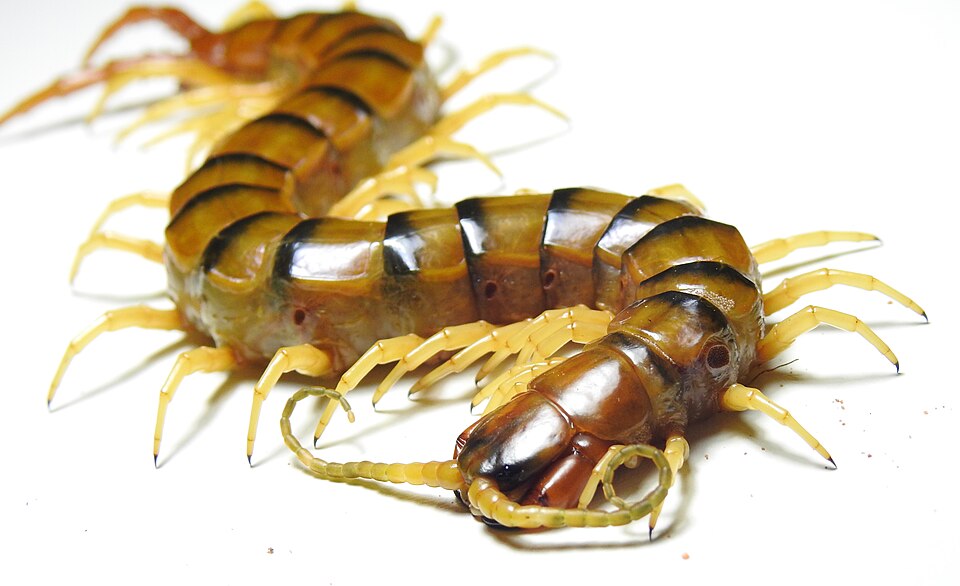
Giant centipede
Ethmostigmus rubripes
Eats: Other bugs and small animalsCentipedes and millipedesRainforests and junglesLots of legsNot an insect, but a bug cousin
The giant centipede is a long, fast centipede with yellow legs and long yellow feelers. Its back can be brown, green, orange or yellow. It hunts alone at night and hides under logs and rocks during the day.
Fun fact: this one is not an insect. Insects have six legs, and this cousin has many, many more.
Lives in
Asia, Australia and Pacific islands, in deserts, woods, rainforests and even towns
What does it eat?
It is a hunter that catches other small animals at night.
How fast is it?
A tortoise about 0.3 km/h (0.19 mph)
Giant centipede about 1.5 km/h (0.93 mph)
A person walking about 5 km/h (3.1 mph)
A kid running fast about 13 km/h (8.1 mph)
cool stuff
Fun facts
1
It has 21 or 23 pairs of legs, so about 42 to 46 legs in total.
2
Its body is made of 25 or 27 segments.
3
It can live in dry deserts and in wet rainforests, which very few animals can do.
4
It likes to be alone and does its hunting at night.
you asked
Most asked questions about Giant centipede
?How many legs does a giant centipede have?
It has 21 or 23 pairs, which makes 42 or 46 legs.
?Where does the giant centipede live?
Across Asia, Australia and the Pacific, under logs, bark, leaves and rocks.
For bug experts
- Scientific name
- Ethmostigmus rubripes
- Named by
- Brandt, 1840
- Group
- Centipedes and millipedes
- Family
- Scolopendridae
- Classification
- Chilopoda > Scolopendromorpha > Scolopendridae
- Lives on
- Asia, Australia and Oceania
Where the facts come from
- Ethmostigmus rubripes (Wikipedia, CC BY-SA 4.0): what it looks like, where it lives, what it eats, sizes and fun facts, retold in simple words.
- Picture by Jackson Nugent. CC BY 2.0, Wikimedia Commons. The round sticker of this bug is cut from the same picture.
If we got something wrong, sorry, we are bug fans, not a science journal. Tell us at [email protected] and we will fix it.
 Giant African millipede
 House centipede
 Amazonian giant centipede
 Vietnamese centipede
 Giant desert centipede
 Greenhouse millipede
 Blue-winged helicopter
 Giant forest ant
 Tropical carpenter bee
 Malachite butterfly
 Rajah Brooke's birdwing
 Trinidad chevron tarantula
.jpg)