

Case-bearing clothes moth
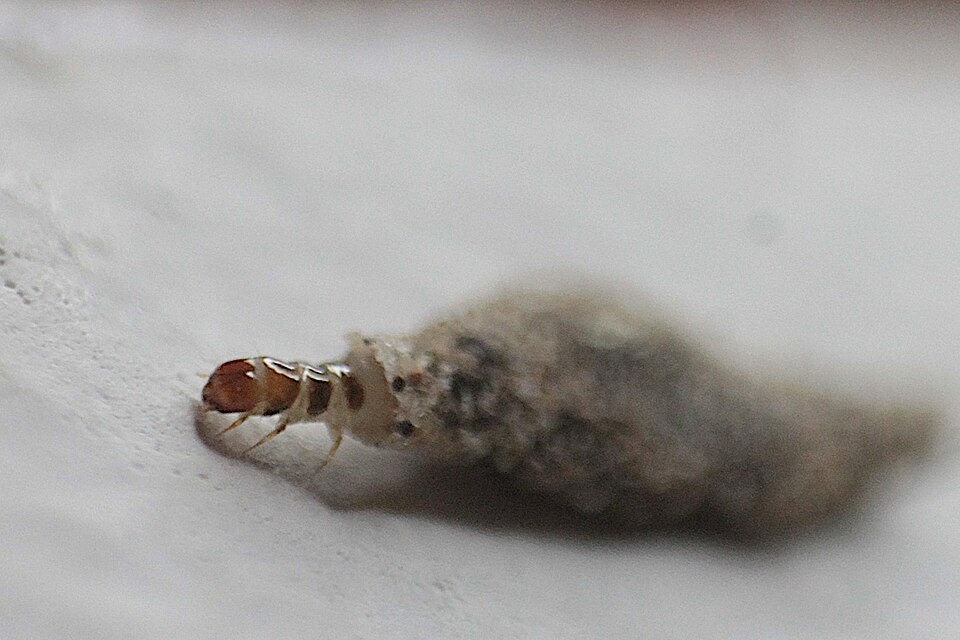
The case-bearing clothes moth is a tiny silvery grey moth with a little tuft of hair on its head. Its caterpillar builds itself a cosy sleeping bag out of hairs and fluff, and carries it everywhere it goes. It likes to live in our homes, close to our woolly clothes.
How big is it?
How wide are its wings?
How big is Case-bearing clothes moth compared to YOU?
Just maths in your browser. Nothing is saved or sent anywhere.
How fast is it?
Fun facts
The caterpillar never leaves its little case. It just pokes out its head and legs and walks around with its house on its back.
Its wings have a soft, hairy fringe around the edges, like a tiny shawl.
It was one of the very first moths that scientists ever described and named.
Grown-up moths are usually seen in summer and early autumn, but inside warm houses they can turn up at any time of year.
It looks so much like some of its cousins that scientists have to look very closely to tell them apart.
Most asked questions about Case-bearing clothes moth
?Do clothes moths eat clothes?
The grown-up moth does not, but its caterpillar does. It eats wool, fur and other things made of hair.
?How big is a case-bearing clothes moth?
It is tiny. Its open wings measure only about 1 to 1.5 centimetres from tip to tip.
?Why does the caterpillar carry a case?
It builds the case from hairs and fibres and stays safely inside it while it eats and grows.
For bug experts
- Scientific name
- Tinea pellionella
- Named by
- Linnaeus, 1758
- Group
- Moths
- Family
- Tineidae
- Classification
- Insecta > Lepidoptera > Tineidae
- Lives on
- Europe, Asia, Africa, North America, South America, Australia and Oceania
- Also known as
- Bagworm
Where the facts come from
- Tinea pellionella (Wikipedia, CC BY-SA 4.0): what it looks like, where it lives, what it eats, sizes and fun facts, retold in simple words.
- Picture by Vitor da Silva Gonçalves. CC BY-SA 4.0, Wikimedia Commons. The round sticker of this bug is cut from the same picture.
If we got something wrong, sorry, we are bug fans, not a science journal. Tell us at [email protected] and we will fix it.
 Atlas moth
 Luna moth
 Hummingbird hawk-moth
 Domestic silk moth
 Isabella tiger moth
 Polyphemus moth
 Museum beetle
 Tailed daddy long-legs spider
 Speckled cockroach
 Australian house centipede
 Pig louse
 Housefly